
CoCounsel vs Vincent AI: Benchmarks, Pricing, and Fit
.jpeg)


CoCounsel and Vincent AI are legal AI platforms built around different legal-content ecosystems.
CoCounsel Legal combines AI with Thomson Reuters content, including Westlaw and Practical Law. Its current platform supports legal research, drafting, document analysis, and multi-step agentic workflows.
Vincent by Clio combines legal AI with the Clio and vLex legal-data ecosystem. The underlying Clio Library provides access to more than one billion legal documents across more than 100 countries, while Vincent supports research, drafting, document analysis, litigation work, and agentic workflows.
The practical choice is therefore not simply which platform has more AI capabilities. It depends on the legal sources the team relies on, the jurisdictions it works across, and how the platform fits into existing research and matter workflows.
Key takeaways
- CoCounsel is closely connected to the Thomson Reuters ecosystem, including Westlaw and Practical Law.
- Vincent combines legal AI with a global legal-data foundation spanning more than one billion documents across more than 100 countries.
- Both products now extend beyond research into drafting, document analysis, agentic workflows, and Microsoft Word.
- The 2025 Vals benchmark provides independent evidence on several document-related tasks, but it did not test legal research and reflects older versions of both products.
What is CoCounsel?
CoCounsel Legal is Thomson Reuters' AI platform for legal research, drafting, document analysis, and multi-step legal work.
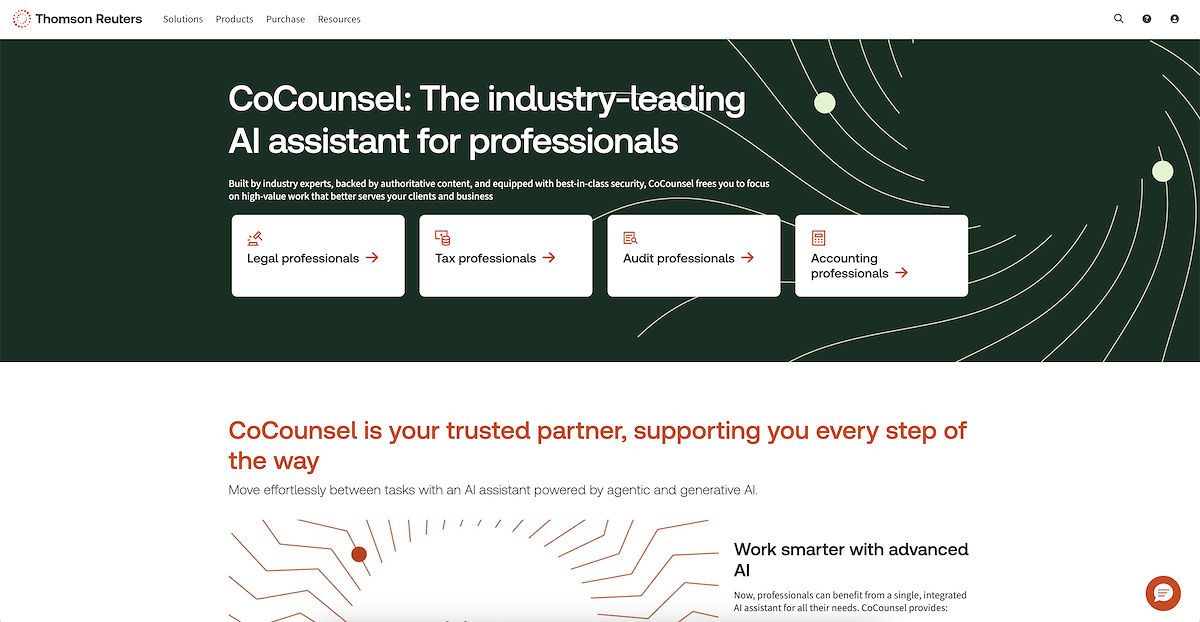
The latest generation of CoCounsel Legal became generally available in the United States in August 2026. It brings research, drafting, legal intelligence, verification, and agentic workflows into an environment grounded in Westlaw and Practical Law.
That connection is particularly relevant to teams that already rely heavily on Thomson Reuters research products.
Current CoCounsel plans include capabilities for legal research, document analysis, drafting, contract Playbooks, deposition preparation, and structured analysis across document sets.
What is Vincent AI?
Vincent is Clio's enterprise legal AI platform for large law firms and legal teams.

Its research foundation includes the Clio Library, powered by vLex, which provides access to more than one billion primary law sources, dockets, and secondary materials from more than 100 countries.
Vincent also extends beyond research. Its current capabilities include document analysis, drafting, litigation work, agentic workflows, and configurable firm-specific processes. Vincent Skills allows organizations to define how recurring legal work should be approached and apply those standards across matters.
Vincent is also available inside Microsoft Word. Clio for Word reads the active document and can propose revisions as native Track Changes. That experience remains in beta for Vincent customers.
CoCounsel vs Vincent AI at a glance
| Dimension | CoCounsel Legal | Vincent AI |
|---|---|---|
| Core focus | Legal research, drafting, analysis, and agentic legal work | Legal research, analysis, drafting, litigation, and agentic workflows |
| Legal-content foundation | Westlaw and Practical Law | Clio/vLex legal-data ecosystem |
| Global research | Thomson Reuters legal-content ecosystem with country-specific offerings | 1B+ legal documents across 100+ countries |
| Document analysis | Yes | Yes |
| Drafting | Yes | Yes |
| Litigation workflows | Research, brief drafting, deposition and document analysis | Research, transcript and document analysis, litigation intelligence |
| Microsoft Word | Document review and drafting capabilities | Native Track Changes through Clio for Word, currently beta |
| Independent Vals testing | Participated in four scored tasks | Participated in five scored tasks |
| Pricing | Public pricing available for some plans; larger teams are sales-led | Enterprise Vincent is sales-led |
How did CoCounsel and Vincent AI perform in independent testing?
The Vals Legal AI Report provides an independent comparison of CoCounsel and Vincent across several common legal tasks.
Vals published the study in February 2025. It evaluated CoCounsel, Vincent AI, Harvey Assistant, and Oliver against a lawyer control group. Vendors chose which categories to enter, so the results do not represent a complete like-for-like comparison.
| Task | Lawyer baseline | CoCounsel | Vincent AI |
|---|---|---|---|
| Data extraction | 71.1% | 73.2% | 69.2% |
| Document Q&A | 70.1% | 89.6% | 72.7% |
| Document summarization | 50.3% | 77.2% | 58.9% |
| Redlining | 79.7% | Did not participate | 53.6% |
| Transcript analysis | 53.7% | Did not participate | 64.8% |
| Chronology generation | 80.2% | 78.0% | Did not participate |
| EDGAR research | 70.1% | Did not participate | Did not participate |
CoCounsel averaged 79.5% across the four tasks it entered. Its scores included 89.6% on document Q&A and 77.2% on document summarization.
Vincent exceeded the lawyer baseline on document Q&A, document summarization, and transcript analysis. Its scores ranged from 53.6% on redlining to 72.7% on document Q&A.
What the benchmark does not tell you
The most important limitation is that the February 2025 report did not evaluate legal research.
Vals deliberately separated legal research into a later study. The scores above therefore should not be used to conclude that either CoCounsel or Vincent provides more accurate legal research.
The results are also a snapshot of older product versions. Thomson Reuters submitted CoCounsel 2.0, and Vincent has changed substantially since the study, including Clio's acquisition of vLex and subsequent product releases.
Vals itself describes the study as temporal because legal AI products evolve quickly.
The benchmark is therefore useful evidence about how particular versions of the products performed on specific document-related tasks. Current evaluations should also test the products on the firm's own research questions, documents, and workflows.
What are the main differences between CoCounsel and Vincent AI?
The clearest differences are the content behind the answers and the ecosystems surrounding the products.
1. The legal-content ecosystems are different
CoCounsel is distinguished by its connection to Thomson Reuters legal content. For organizations already using Westlaw and Practical Law, CoCounsel brings AI into a research environment built around sources and practical guidance the team may already use extensively.
Vincent is distinguished by the breadth of the Clio/vLex legal-data ecosystem. The Clio Library includes primary law, dockets, secondary materials, and other legal sources across more than 100 countries.
The comparison should not be reduced to "CoCounsel for the United States and Vincent for everywhere else." Instead, teams should compare the actual jurisdictions, sources, citators, secondary materials, and practical guidance required by their work.
2. The surrounding platforms matter
The legal library is only one part of the decision. CoCounsel increasingly connects research, drafting, document analysis, and matter-centric workflows within the broader Thomson Reuters environment.
Vincent increasingly sits inside Clio's enterprise platform and can combine legal authority with matter information, firm knowledge, and connected document sources. Vincent has also been integrated into Clio Operate for enterprise legal work. The surrounding technology stack can therefore affect the choice as much as an individual AI capability.
A team already deeply invested in one ecosystem may evaluate the cost and workflow implications differently from a team making a greenfield purchase.
3. Microsoft Word is becoming less of a differentiator
Both companies are extending substantive legal work into Microsoft Word. Vincent's Clio for Word can read an active document, including comments and existing redlines, and propose edits as native Track Changes. The product remains in beta.
CoCounsel also supports document review and drafting through its broader product environment. The more useful question is therefore not whether a Word integration exists, but how naturally research, authority, matter context, and document work move together in each platform.
How do CoCounsel and Vincent AI compare on pricing?
CoCounsel now provides more public pricing information than many older comparisons suggest.
Thomson Reuters publishes pricing for several CoCounsel plans, including CoCounsel Essentials and packages that combine CoCounsel with Westlaw or Practical Law. Firms with more than 10 attorneys are directed to sales for customized pricing, and CoCounsel Essentials offers a free-trial route.
Vincent's large-firm and enterprise offering remains primarily sales-led.
Clio separately publishes a per-user pricing structure and free-trial route for Clio Work, but teams should not assume that pricing is equivalent to an enterprise Vincent deployment.
For either product, compare the total package rather than a headline seat price. Relevant variables include legal-content access, number of users, document-management integrations, implementation, training, and the specific research or workflow modules required.
Which should your team choose?
The better choice depends primarily on the legal information and workflows the team uses most.
CoCounsel may be the stronger fit if:
- Westlaw and Practical Law already form a central part of the research stack.
- The team wants research, drafting, and document analysis closely connected to Thomson Reuters authority.
- U.S. legal research is a major part of the workload.
- The organization wants agentic workflows within the Thomson Reuters ecosystem.
Vincent AI may be the stronger fit if:
- Broad international research is a major requirement.
- Matters regularly span multiple jurisdictions.
- The team values the breadth of Clio's one-billion-plus legal-source library.
- The organization is adopting the wider Clio enterprise environment.
- The team wants to evaluate Vincent's emerging native Track Changes workflow inside Word.
For either platform, a representative pilot is more useful than feature-counting. Test several research questions the lawyers already know well, include real matter documents, and assess source quality, verification, workflow, and the amount of lawyer correction required.
Where Spellbook fits for contract-heavy teams
Spellbook addresses a different primary workflow. It is not a substitute for CoCounsel or Vincent when the core requirement is case-law research, citator functionality, litigation intelligence, or broad multi-jurisdiction legal research. Spellbook is centered on commercial contract review, drafting, redlining, and negotiation.
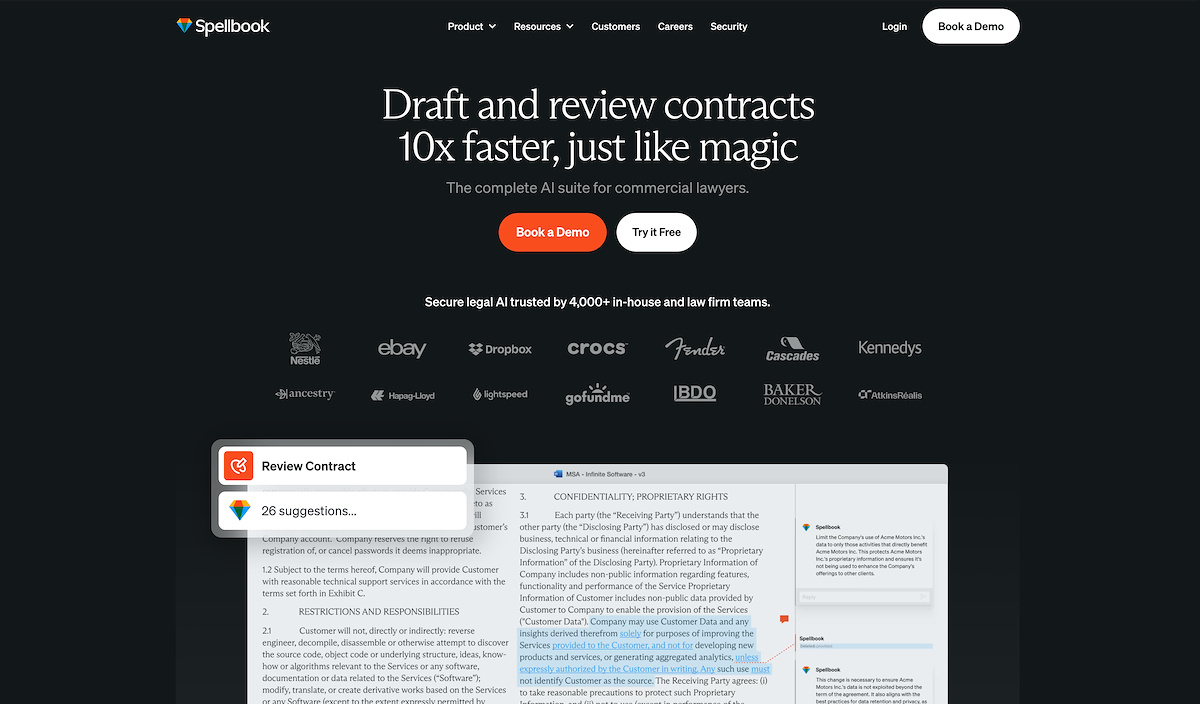
Review works directly inside Microsoft Word, identifies potential contract issues, and provides suggested redlines and comments. Playbooks allow teams to apply their own review standards consistently.
Compare to Market adds external context when negotiations turn on how a provision compares with similar agreements.
This means the categories can be complementary rather than mutually exclusive. A legal team may need a research platform for authority-driven work and a contract-focused platform for recurring commercial agreements.
Test the workflow that is creating the bottleneck
CoCounsel and Vincent increasingly cover many of the same broad categories of legal work. Their legal-content foundations and surrounding ecosystems remain important distinctions.
If research and authority are central to the workload, compare the sources, jurisdictions, verification tools, and matter workflows behind each platform.
If the recurring problem is commercial contract review and negotiation, evaluate that workflow separately rather than assuming a research-led platform must also be the right contract tool.
The useful starting point is the legal work consuming the team's time, not the length of the feature list.
Disclaimer: Product features, availability, and pricing may change. This comparison is based on publicly available information as of September 2026. Teams should confirm current capabilities, availability, and commercial terms directly with each vendor.
.png)
%20(1).png)
.png)
Get buy-in, compare platforms, and make AI stick.



Submission Received
Thank you for your interest!
.svg)
