


Contract Risk Assessment: A Complete Guide for Legal Teams


A contract risk assessment identifies, scores and prioritizes the risks inside a contract before it is signed. The five categories of contract risk are financial, legal, compliance, operational and reputational, and most of the exposure sits in a short list of clauses: liability caps, indemnities, termination and auto-renewal terms, intellectual property, data protection and dispute resolution. A contract risk assessment checklist turns those clauses into review questions, and a six-step process moves from contract inventory through counterparty checks, likelihood-and-severity scoring, mitigation and continuous monitoring. Contract risk assessment tools automate the detection step, and legal teams run the full assessment at pre-signature review, at renewal, and in periodic portfolio audits.
Most teams do not have the hours this takes. Contract volume rises faster than legal headcount, so the assessment becomes a sample rather than a standard, and the agreements nobody read are the ones that produce disputes. Running the assessment inside the Review feature, where the drafting already happens, can bring the full portfolio into scope instead of a sample of it.
Key Takeaways
- Five risk categories: A contract risk assessment covers financial, legal, compliance, operational and reputational risk, and each category has its own detection method.
- Six clause families carry most of the exposure: Limitation of liability, indemnification, termination and auto-renewal, intellectual property, data protection, and dispute resolution.
- Scoring decides review depth: Likelihood weighed against severity sets which provisions get standard review and which need senior approval.
- Assessment is continuous: Pre-signature review, renewal and periodic portfolio audits each surface different risks.
[cta-1]
What Is Contract Risk Assessment?
Contract risk assessment differs from contract review in what it produces: a review returns a redline, and an assessment returns a scored, prioritized record of what the organization is accepting if it signs. The assessment tests how specific terms could expose the organization to financial loss, legal liability, or operational disruption.
The scale of the problem is measurable at the drafting stage, before a contract ever reaches a risk review: 60% of material contracts filed by public companies with the SEC contain drafting errors, according to Spellbook Labs' analysis of 3,019 material-contract exhibits filed on EDGAR by more than 500 public companies. A risk assessment catches many of the same defects a reviewer would otherwise only find after a dispute forces a second look at the document.
A contract risk assessment is not a one-time event. Legal teams run it at three distinct moments:
- Pre-signature review, before the agreement is executed and the terms are still negotiable.
- Renewal, when terms and counterparty circumstances may have changed since the last review.
- Periodic portfolio audits, which catch risk that accumulated across the live book of contracts after signature.
It is also not legal's job alone: procurement sets the commercial terms a contract risk assessment later tests, and the business owner who requested the agreement is usually the first person to notice when a counterparty stops performing the way the contract assumed.
The 5 Types of Contract Risk
| Risk Type | Definition | What It Looks Like in the Document | How You Detect It |
|---|---|---|---|
| Financial | Exposure that converts directly into monetary loss | Uncapped liability, unfavorable payment and auto-renewal pricing, penalty triggers on missed deadlines | A document read against the payment and liability clauses |
| Legal | Exposure to litigation or an unenforceable position | Breach claims, poorly drafted intellectual property assignment, ambiguous governing law and venue | A clause comparison against the playbook position |
| Compliance | Failure to meet a regulatory requirement | Missing data processing terms under the GDPR, no business associate agreement where HIPAA applies, absent sanctions screening | Mapping the clause against the regulatory regime the deal touches |
| Operational | Risk created by day-to-day administration of the agreement | Unclear deliverable ownership, missed milestones, service levels with no remedy | Obligation and milestone tracking after signature |
| Reputational | Damage to the brand from how the agreement performs | Public disputes, ethical sourcing failures, partnership breakdowns | Counterparty and public-record screening |
A single clause can carry more than one of these risk types at once. A compliance-focused portfolio audit checks that same clause against a different standard than the one-time pre-signature review does, since risk can accumulate after signature even when nothing in the clause itself has changed.
High-Risk Contract Clauses and What to Check in Each
Six clause families carry most of the risk in a commercial contract: limitation of liability, indemnification, termination and auto-renewal, intellectual property ownership, data protection, and dispute resolution. A clause-level review checks each one for a missing protection, a non-standard limit, or language that shifts an obligation from the counterparty onto your side.
Limitation of Liability
A liability cap is usually written as a multiple of fees paid over a defined period, commonly one times fees paid and often negotiated up to two or three times for higher-risk deals. The cap should also exclude a defined set of carve-outs. Breach of confidentiality, intellectual property (IP) infringement, and gross negligence or willful misconduct are the three that appear most often outside the cap. Check whether the cap is mutual, since a one-way cap that protects only the counterparty shifts risk onto your side without a matching concession. Confirm the clause excludes consequential, indirect and punitive damages rather than leaving the exclusion implied.
Indemnification
An indemnification clause needs a defined scope (which claims trigger it), a named party who controls the defense once a claim is asserted, and a notice-and-cooperation obligation that sets a deadline for telling the indemnifying party about a claim. Check whether the indemnity survives termination: a clause that is silent on survival can be read to end with the contract, which leaves a claim arising after termination with no remedy. A reviewer who finds the indemnity undefined or one-sided marks the clause for negotiation rather than drafting new language from scratch, turning the proposed fix into a redline on the contract itself.
Termination and Auto-Renewal
Termination risk concentrates in the notice window: how many days before the term ends a party must act, and who on your side actually diaries that date. An auto-renewal clause that renews silently if nobody sends notice in time converts a negotiating decision into a default, and many auto-renewal clauses also step the price up on renewal with no new negotiation. Check whether termination for convenience exists at all, and if it does, whether it carries a notice period long enough to transition the relationship. The failure mode is rarely the clause language; it is that the notice period runs from a date nobody is watching.
Intellectual Property Ownership
Intellectual property ownership clauses separate work product the counterparty creates for you from the background IP they brought into the engagement, and the license back to any background IP should state its scope (internal use only, versus a sublicensable right to your own customers) clearly. A residual-knowledge clause, which lets the counterparty's personnel retain and reuse general knowledge gained on the engagement, can quietly narrow an otherwise strong ownership assignment, so check that it is limited to genuinely general knowledge and does not reach your confidential information.
Data Protection
Where a counterparty processes personal data on your behalf, the agreement needs processor terms that satisfy GDPR Article 28: the processing purpose, the data categories, the security obligations, and the sub-processor consent mechanism. That obligation applies regardless of deal size, since processor status turns on what the counterparty does with the data, not on how much of it moves or how large the contract is. Where the counterparty will create, receive, maintain or transmit protected health information on your behalf, HIPAA requires a business associate agreement, and its breach-notification window should be stated in days rather than "promptly." Check that any new sub-processor requires your consent rather than simple notice after the fact.
Dispute Resolution
Governing law and venue decide which court or arbitral body hears a dispute and which substantive rules apply; a clause that is silent or ambiguous on either can leave the parties arguing over venue before they reach the merits. Check whether arbitration or litigation is specified, whether the clause allocates attorneys' fees to the losing party, and whether it carries an injunctive-relief carve-out for breaches (confidentiality is the common case) that cannot wait for an arbitration panel to convene. Check whether the fee-shifting provision is mutual, and whether the forum is one your organization can realistically litigate in, since a clause that sends every dispute to a distant venue raises the practical cost of enforcing the agreement.
Contract Risk Assessment Checklist
A contract risk assessment checklist runs an agreement through the five risk categories in a fixed order, so two reviewers reach the same conclusion on the same paper. Each line is a question with three possible answers: acceptable as drafted, needs negotiation, or escalate for senior approval. Public-sector procurement teams run a similar pass: Washington State's own contract risk assessment checklist assigns a point-weighted score across service risk factors, each mapped to a response strategy.
1. Financial
- Are invoicing schedules, late fees, currency conversion, and tax responsibilities clearly defined?
- Is liability capped, and does the cap reflect the deal's actual size and risk?
- Does the auto-renewal clause step the price up without a new negotiation?
- Are penalty or liquidated-damages triggers tied to a specific, measurable failure?
2. Legal
- Is governing law and venue specified and acceptable to your organization?
- Does the indemnification clause name a defined scope and a notice obligation?
- Are intellectual property ownership and license terms unambiguous?
- Is the dispute resolution mechanism (arbitration or litigation) stated?
3. Compliance
Compliance questions test coverage against the regulatory regime the agreement actually touches, not just the presence of a privacy clause.
- Does the contract include a data processing addendum where personal data is involved?
- Is a business associate agreement in place where HIPAA applies?
- Are sanctions and denied-party screening requirements addressed?
- Does the agreement state a breach-notification window in days?
- Is data residency or cross-border transfer addressed where it applies?
The tools built for compliance-focused review are designed to flag these processing and notification terms, which a generic clause-by-clause pass tends to treat as boilerplate rather than a line that needs its own check.
4. Operational
- Are deliverables, milestones and acceptance criteria defined?
- Does the agreement set a service level with a defined remedy?
- Is ownership of each obligation assigned to a named role, on both sides?
- Are change-order and scope-change procedures specified?
5. Reputational
- Does the agreement name standards the counterparty must meet (ethical sourcing, labor practices)?
- Is there a right to audit or terminate for a standards breach?
- Are public statements about the relationship restricted or subject to review?
- Does a dispute under this agreement carry disclosure obligations that could become public?
A due diligence checklist runs a related but more deal-specific version of this same pass, built for the single transaction in front of a team rather than the standing portfolio review.
[cta-2]
How to Conduct a Contract Risk Assessment
A contract risk assessment runs in six steps, from organizing the contract inventory through to continuous monitoring after signature.
1. Identify Contract Types and Organize Inventory
Every active agreement needs to sit inside one contract lifecycle management system, not scattered across whoever happened to draft it. Without that, the next five steps run on a sample instead of the whole portfolio.
- Group contracts by type (vendor, customer, employment, NDA) so review standards match the risk profile.
- Flag contracts with no clear owner on the business side first; those are the ones nobody is watching.
- Record the renewal or expiration date for every contract at intake, not after the fact.
2. Review Key Clauses and Terms
The review runs clause by clause against a written review policy, which fixes who checks each clause type, in what order, and against what standard, so two reviewers do not quietly apply different judgment calls to language that looks the same on the page.
- Escalate any clause that departs from the playbook position rather than approving it on the reviewer's own judgment.
- Log the specific deviation, not just a flag, so the next reviewer does not have to re-derive it.
- Flag ambiguous terms for negotiation before the clause reaches the counterparty's final sign-off.
- Keep the fixed review order the same across reviewers, rather than letting each person work through the document their own way.
3. Evaluate Counterparty Risk
Counterparty risk sits outside the document, in who you are signing with. Pull the counterparty's recent public filings, check sanctions and denied-party lists, and review prior-performance history on past agreements before scoring the contract itself.
- Check sanctions, denied-party and debarment lists before signature, not after.
- Pull recent public filings or financial statements for counterparties with meaningful contract value.
- Review prior-performance history: missed deliverables, late payment, disputed invoices.
- Confirm the signing entity actually has authority to bind the counterparty named in the recitals.
A formal due diligence pass adds verification a basic filings check does not, particularly for a counterparty the organization has not worked with before.
4. Score Likelihood and Severity
Scoring runs on two axes: likelihood of the risk occurring, scored 1 to 5, against severity if it does, scored 1 to 5. The product of the two sets review depth, so a low-likelihood, high-severity risk (an uncapped indemnity with a large counterparty) still routes to senior review even though it may never trigger. Public-sector buyers run the same prioritization with a simpler instrument. The University of Illinois contract risk assessment matrix scores each risk factor on a single 1-to-3 scale and routes any factor scoring 3 straight to its central procurement office for a closer look, which is a coarser version of the same idea. A different public-sector buyer takes a five-factor approach instead: the National Association of Counties contract risk assessment scorecard, a San Bernardino County entry, scores five contract-level areas to set how often a contract gets audited.
- Score likelihood and severity separately before combining them; a single blended "risk level" hides which factor is driving the score.
- Set a fixed threshold (for example, any score of 15 or higher on a 25-point grid) that automatically routes to senior review.
- Re-score after a negotiated change, since a redline that caps liability or adds a termination right changes both axes.
- Document the score with the clause, not in a separate spreadsheet nobody checks during the next review.
AI contract risk scoring automates exactly this step, assigning the likelihood and severity axes directly from the clause language rather than from a reviewer's manual estimate.
5. Develop Mitigation Strategies
Negotiate the specific clause language first; a fallback position only matters once the counterparty will not move on the primary ask, and the fallback should come from the team's own contract playbook rather than getting improvised mid-negotiation.
- Add a contractual safeguard (insurance requirement, security deposit, performance bond) where the clause itself cannot be improved further.
- Assign a named owner for each accepted risk, so the risk has someone who can be asked about it at the next review.
- Record which fallback position was used, not just that one was, so the playbook can be updated if it keeps getting used.
6. Monitor and Re-Assess Continuously
- Re-run the assessment at renewal, not just at signature; terms and counterparty circumstances both change.
- Track obligation and renewal dates on a calendar a person actually checks, not just in the signed PDF.
- Re-score any contract after a material amendment, not only at the scheduled review date.
Monitoring findings feed back into the ongoing contract review process: a risk flagged this quarter becomes a known issue the next reviewer checks first, instead of a note that sits in a closed file.
How Contract Risk Assessment Fits Into Contract Risk Management
Contract risk management is the full process of assessing, mitigating, monitoring and escalating contract risk across the lifecycle, and contract risk assessment is its first stage. Treating the assessment as the whole contract risk management process is why identified risks still reach signature with no owner, no fallback position and no review date.
The four stages sit with different owners:
- Assessment: scoring every clause against the categories above, typically a reviewer or a legal operations role.
- Mitigation: negotiating the clause or adding a contractual safeguard, sitting with the reviewing attorney and whoever owns the business relationship.
- Monitoring: tracking obligation and renewal dates across the live portfolio, usually landing with legal operations or contract management rather than the original reviewer.
- Escalation: routing a risk that crosses a threshold to senior counsel or the business owner, closing the loop back to a decision-maker who can accept, reject or renegotiate the risk.
The hand-off between assessment and mitigation is where risk most often gets dropped: an assessment that flags a clause but does not name who owns fixing it produces a risk register nobody acts on. Without that hand-off built into the contract review workflow itself, a flagged risk sits unresolved until the next audit finds it again.
Contract Risk Assessment Tools and Frameworks
| Category | What It Does | What It Does Not Do | When a Legal Team Needs It |
|---|---|---|---|
| Risk matrices | Scores a clause or contract on likelihood against severity using a fixed grid | Does not read the contract or flag the clause itself; someone has to score it manually | Standardizing review depth across reviewers of different experience levels |
| Clause libraries and playbooks | Store approved and fallback language for each clause type | Do not compare a specific agreement's language against the library automatically | Keeping negotiated positions consistent across deals and reviewers |
| Obligation and renewal trackers | Track dates (renewal, termination notice, deliverable deadlines) after signature | Do not assess risk at the clause level or catch drafting errors | Portfolios large enough that a missed notice date is a real, recurring failure mode |
| AI contract review | Reads the agreement, flags deviations from the playbook, and proposes language | Does not replace legal judgment on what to accept, negotiate or escalate | Review volume high enough that manual, clause-by-clause reading is the bottleneck |
Risk matrices and playbooks solve different problems: a matrix tells a reviewer how deep to look, and a playbook tells them what the acceptable language actually is. Obligation trackers solve a problem neither one touches: a missed notice or renewal date is a common post-signature failure that neither a matrix nor a playbook catches.
AI contract review is the category that automates the detection step across all three, and it covers two different jobs that are easy to conflate:
- Single-contract review compares a specific clause against a playbook position inside one agreement, and it is the job most legal teams mean when they say "AI contract review" in the first place.
- Document-set analysis scans across an entire set of agreements at once, flagging the same kind of issue everywhere it appears rather than inside one agreement at a time.
Legal AI tools in this category span both jobs, and the single-contract comparison is usually the one a buyer evaluates first, since it is the capability most vendors lead with in a demo. None of the four categories removes the need for a reviewer to decide what a flagged clause actually means for the deal.
Common Mistakes in Contract Risk Assessment
Five mistakes undermine most contract risk assessment programs: inconsistent reviews across reviewers, treating assessment as the legal department's job alone, no single current draft during negotiation, a reactive review that starts only after a dispute, and auto-renewal clauses nobody reads.
- Inconsistent reviews across reviewers. Without a shared checklist and scoring scale, two reviewers can read the same clause and reach different conclusions, which makes the assessment depend on who happened to run it.
- Treating assessment as the legal department's job alone. Procurement sets commercial terms that carry financial risk, and the business owner who requested the agreement usually notices performance problems before legal does.
- No single current draft during negotiation. Redline rounds that move through email threads leave the "latest version" a guess rather than a fact, and a risk flagged on an earlier draft can survive into the signed version unresolved.
- A reactive review that starts only after a dispute. Assessment that happens at signature catches a clause before it matters; assessment that happens after a dispute only documents what the clause already cost.
- Auto-renewal clauses nobody reads. The notice window closes before anyone checks the date, the contract renews by default, and the price often steps up on renewal with no new negotiation to show for it.
How AI Transforms Contract Risk Assessment
AI contract risk assessment moves detection from a manual clause-by-clause read to an automated pass that flags non-standard clauses, missing protections and compliance gaps across the whole agreement. The judgment stays with the lawyer: an AI contract risk assessment tool surfaces candidates for review, and a reviewer decides what is acceptable, what gets negotiated and what escalates.
That shift shows up across the steps above. Spellbook's platform covers four of them directly:
- The Review feature surfaces risks and proposes redlines as native Word tracked changes, checked against the playbook position the team already agreed.
- Compare to Market benchmarks a clause against 20M+ real contracts and shows whether a term sits above, at or below market, which gives the severity side of step 4's scoring an external reference point instead of a reviewer's own sense of normal.
- Playbooks hold the standard a team has already approved, so two reviewers scoring the same clause reach the same conclusion rather than relying on individual judgment.
- Proofread catches many of the same drafting errors before the contract ever reaches a risk review.
Compare to Market draws that comparison from real negotiated language, giving a reviewer a documented comparison rather than an unaided judgment call. The same holds for the other three capabilities: a playbook, a redline and a proofread pass all give the reviewer something concrete to check the agreement against instead of relying on memory alone.
A manual, clause-by-clause pass covers only a sample of the portfolio. AI-assisted review extends that reach across the whole set of contracts, including the ones nobody thought to flag for a second look.
Building a Repeatable Contract Risk Assessment Process
Contract risk assessment holds up when it is the same every time: one checklist, one scoring scale, one escalation path, and a tool that applies them to every agreement rather than a sample. Contract risk assessment software enforces that consistency inside the document where the review already happens.
Try Spellbook free to see how contract risk assessment runs inside the document your team already drafts in.
[cta-3]
Frequently Asked Questions About Contract Risk Assessment
Is Contract Risk Analysis the Same as Contract Risk Assessment?
Contract risk analysis and contract risk assessment describe the same underlying work: identifying and evaluating the risks inside an agreement. In practice, "analysis" is used more often for the clause-level read (what a specific term means and how it compares to market) and "assessment" for the broader process that scores and prioritizes findings across a contract or a portfolio. Treat the two as synonyms rather than separate steps.
What Criteria Do Organizations Use to Measure Contract Risk?
Organizations typically score contract risk on likelihood and severity, then weigh the result against the counterparty's track record, the deal's financial size, and the regulatory regime the agreement touches. A contract with a large counterparty, significant financial exposure, and a regulated data type scores higher than an otherwise similar agreement without those factors, even before a single clause is reviewed.
How Often Should Contracts Be Reviewed for Risk?
A contract risk assessment runs at three points: before signature, at each renewal, and on a periodic schedule across the live portfolio (commonly annually for standard agreements, more often for high-value or high-risk categories). An amendment or a material change in the counterparty's circumstances also triggers an out-of-cycle re-assessment.
Who Should Own Contract Risk Assessment?
Legal typically owns the clause-level review, but contract risk assessment works best as a shared process: procurement flags financial and commercial risk at the term-sheet stage, the business owner reports performance issues after signature, and legal operations or contract management tracks the dates and findings across the portfolio. A program that routes every risk through legal alone misses the risk the business side sees first.
Can AI Replace Lawyers in Contract Risk Assessment?
No. An AI tool can read a contract, compare it against a playbook, and flag deviations faster than a manual pass, but it does not replace the judgment call on what a flagged clause means for a specific deal, a specific counterparty, and a specific business goal. ABA Formal Opinion 512 addresses this directly: a lawyer using a generative AI tool still has to verify its output and supervise its use, and that duty does not shift to the tool.

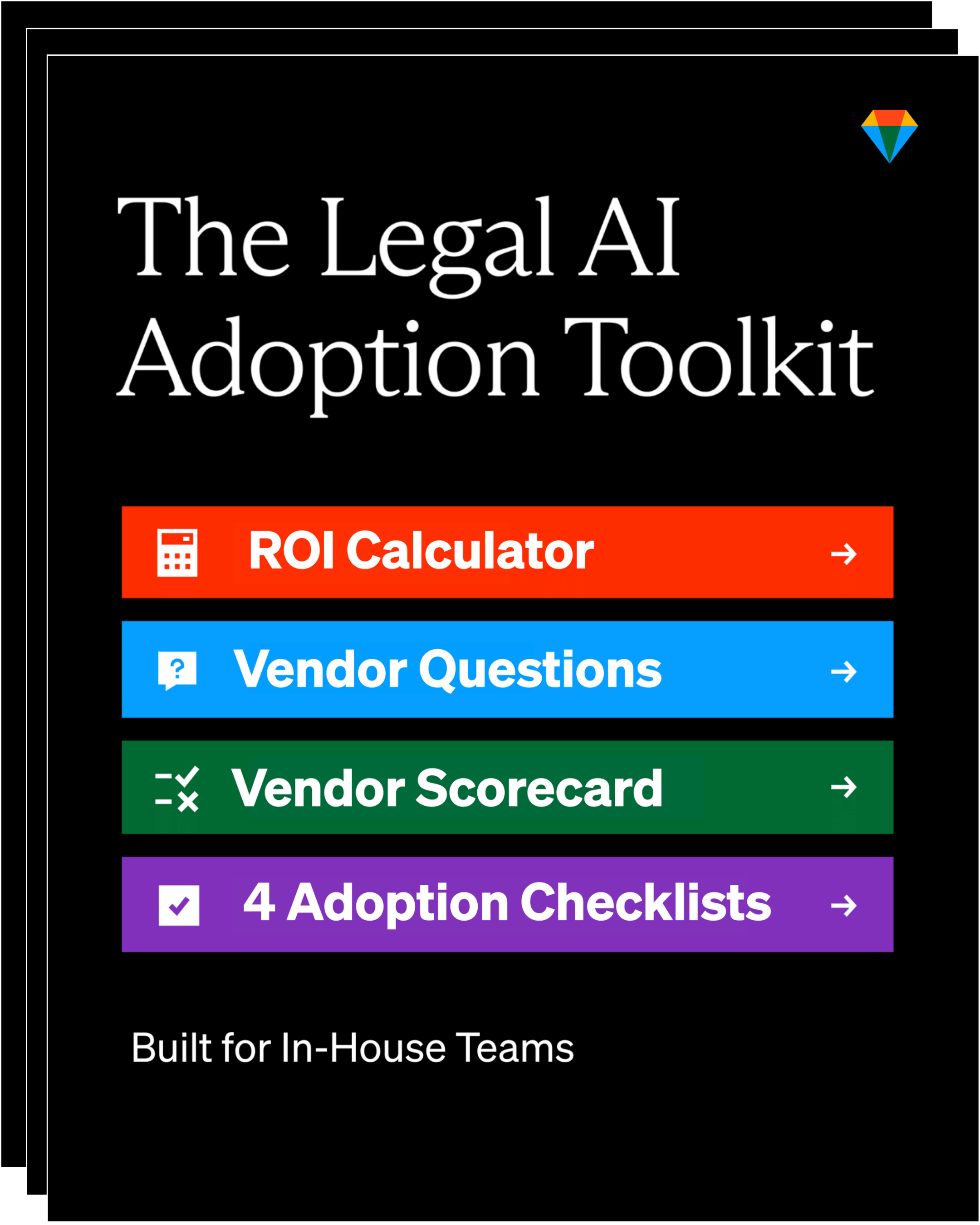
Get buy-in, compare platforms, and make AI stick.




Submission Received
Thank you for your interest!

