
Legora Alternatives: 6 Options Compared by Use Case
.jpeg)

The right Legora alternative depends on which part of the platform your team is trying to replace.
Legora has expanded into a broad legal AI platform spanning research, drafting, redlining, large-scale document review, workflows, and agentic legal work. Tabular Review supports structured analysis across document sets, while the Word Add-In supports reviewing, drafting, and redlining directly in Microsoft Word.
That breadth means different alternatives make sense for different workflows. A commercial team may prioritize contract review and negotiation. A research-led practice may care more about the legal sources behind the AI. A large firm handling diligence or litigation may want another broad enterprise platform. An in-house team may prioritize flexibility across several types of legal work.
This guide compares six Legora alternatives based on those use cases rather than treating them as interchangeable products.
Key takeaways
- Legora covers a broad range of legal work, so the most relevant alternative depends on which workflow matters most.
- Spellbook and LegalOn are centered more heavily on commercial contract work, while CoCounsel and Vincent bring legal-research ecosystems into the comparison.
- Harvey is another broad legal AI platform spanning research, document analysis, drafting, contracts, and agentic workflows.
- GC AI is designed around the varied day-to-day work of in-house legal teams and publishes an individual plan alongside team pricing.
Why do teams consider Legora alternatives?
Legora now covers a wide range of workflows, including large-scale document review, legal research, drafting, Microsoft Word, configurable workflows, and agentic legal work.
That breadth can also make the buying decision more specific.
A narrower workflow may matter more. If most lawyer time goes into reviewing and negotiating commercial agreements, a contract-focused product may deserve separate consideration.
Research content may determine the decision. Firms already invested in Westlaw, Practical Law, or a global legal-research library may want AI connected directly to those sources.
The surrounding technology stack matters. Microsoft Word, document management systems, matter systems, internal knowledge, and business applications can affect how naturally a product fits into existing work.
The commercial model may differ. Legora introduced consumption-based pricing for Agent Pro in June 2026, alongside its existing platform model. Teams should therefore compare the commercial structure attached to the specific products and workflows they expect to use.
Legora alternatives at a glance
| Alternative | Best fit | Primary emphasis | Evaluation |
|---|---|---|---|
| Spellbook | Commercial contract-heavy teams | Review, redlining, drafting, Playbooks, negotiation context | Self-serve trial; custom team pricing |
| Harvey | Large firms and enterprise legal teams | Broad legal AI, agents, research, diligence, contracts, knowledge | Demo-led |
| CoCounsel Legal | Research-led teams using Thomson Reuters | Westlaw and Practical Law-grounded research, drafting, and analysis | Public pricing for some plans; demo/trial options |
| LegalOn | Teams prioritizing structured contract review | Playbook-driven review, drafting, and contract intelligence | Free trial; custom team pricing |
| GC AI | In-house legal teams handling varied work | Research, drafting, contract review, playbooks, and connected workflows | $500/month individual plan; 14-day free trial |
| Vincent by Clio | Research-heavy and cross-border legal teams | Global legal research, litigation, document analysis, agentic work | Demo-led enterprise deployment |
The table is a starting point rather than a ranking. Several of these products overlap, so the useful distinction is the workflow each team needs to improve.
1. Spellbook: for commercial contract review and negotiation
Spellbook is particularly relevant when the workload is dominated by reviewing, drafting, and negotiating commercial agreements rather than broad legal research or firm-wide litigation work.
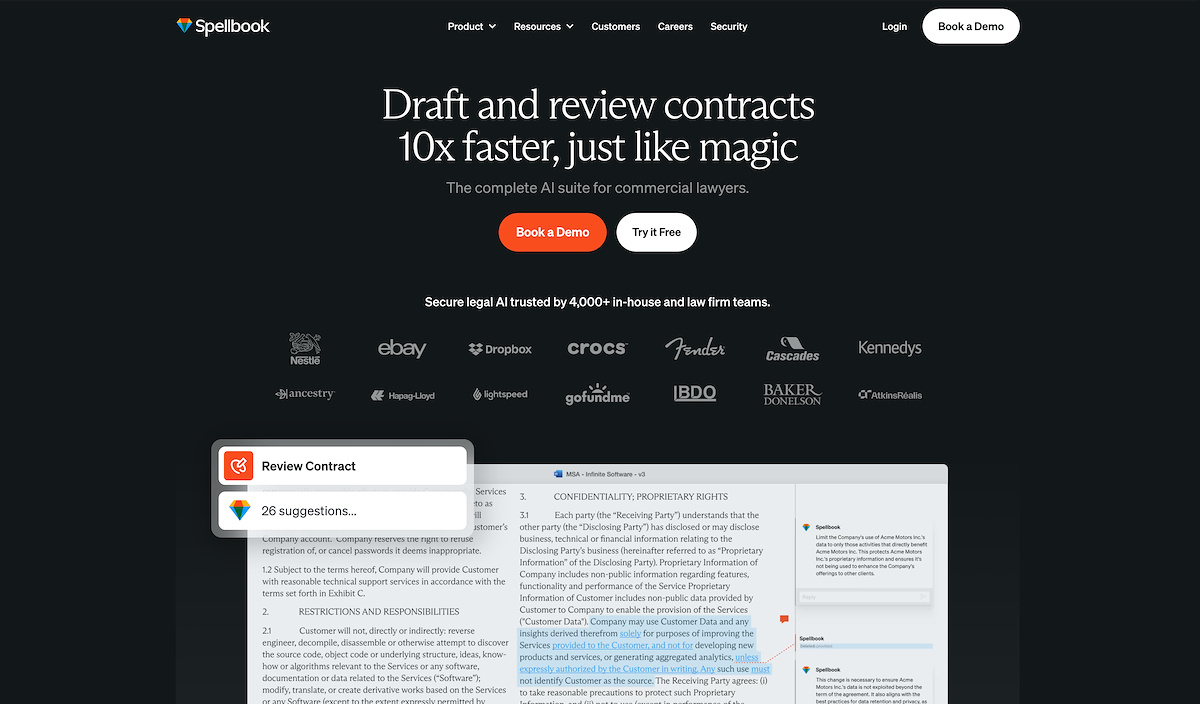
Spellbook Review works directly inside Microsoft Word, identifies potential contract issues, and provides suggested redlines and comments. Playbooks let legal teams apply their own review standards consistently across agreements.
Compare to Market adds external negotiation context by comparing provisions with similar agreements. Associate supports multi-step work across document sets when a matter extends beyond a single contract.
Spellbook may therefore be relevant when recurring work includes:
- first-pass contract review;
- redlining counterparty paper;
- applying preferred and fallback positions;
- drafting clauses and agreements;
- evaluating whether a negotiated position is common in comparable agreements; and
- working across related transaction documents.
Spellbook is not positioned as a substitute for Legora's broader legal-research or litigation capabilities. Teams that depend heavily on case-law research, litigation workflows, or large-scale structured extraction should evaluate those requirements separately.
2. Harvey: for broad enterprise legal AI
Harvey is another broad legal AI platform for teams comparing Legora at the enterprise level.
Its platform includes Agents, research and knowledge tools, document analysis, drafting, Microsoft Word workflows, shared workspaces, and multi-step legal work.
Harvey has also expanded significantly into contracts. Contract Intelligence supports contract intake, playbook-grounded review, precedent analysis, portfolio insights, obligations, and structured contract workflows.
That creates meaningful overlap with Legora across document analysis, contracting, research, and agentic work.
For teams comparing the two, relevant questions include how each handles representative matters, integrations, institutional knowledge, deployment, and the specific workflows the organization intends to standardize.
Harvey does not publish standard public subscription pricing, and evaluation is primarily demo-led.
3. CoCounsel Legal: for Thomson Reuters research workflows
CoCounsel Legal is relevant when Thomson Reuters content is an important part of the buying decision.
CoCounsel Legal combines legal research, drafting, document analysis, and agentic workflows with Westlaw and Practical Law. Its current plans include Deep Research, document analysis, drafting, contract Playbooks, and litigation-oriented workflows.
For firms already relying heavily on Westlaw or Practical Law, that connection may be an important distinction.
Legora also offers legal research as part of its wider platform, but CoCounsel is built directly around the Thomson Reuters research ecosystem.
Thomson Reuters publishes pricing routes for some CoCounsel plans and offers a free-trial route for CoCounsel Essentials, while larger teams are directed to sales.
4. LegalOn: for playbook-driven contract review
LegalOn is relevant when the team wants contract review and drafting built around structured legal standards.
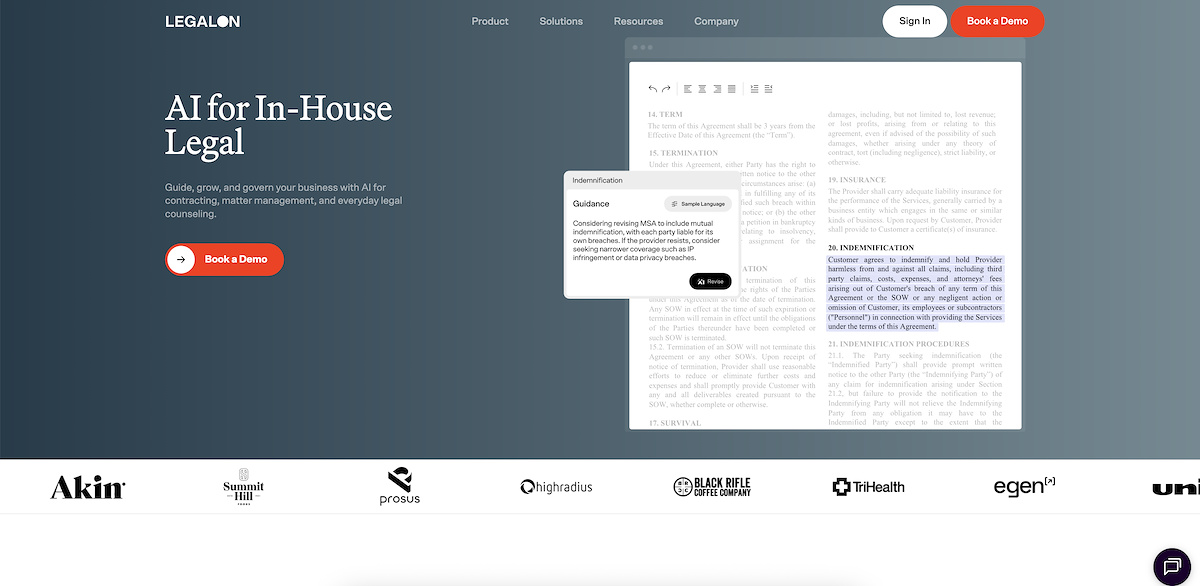
Its contract review workflow can analyze and redline agreements using playbooks. LegalOn also offers custom Playbooks, drafting tools, contract intelligence, and related contract-management capabilities.
One distinction is its library of 50+ attorney-built Playbooks for common agreement types and negotiating positions. Teams can also create Playbooks based on their own preferred positions, fallback language, and risk tolerances.
This can provide a starting point for teams that have not fully documented their internal standards.
Organizations with established negotiation policies should still test how their own positions, exceptions, and preferred language translate into the platform rather than treating vendor-authored content as a substitute for internal policy.
LegalOn uses custom pricing based on team size and required capabilities and offers a free trial for review, redlining, and its AI Assistant.
5. GC AI: for broad in-house legal work
GC AI is designed around the varied workload of in-house counsel. Its platform combines legal research, contract review, Playbooks, drafting, Microsoft Word, document editing, and connectors to other business applications.
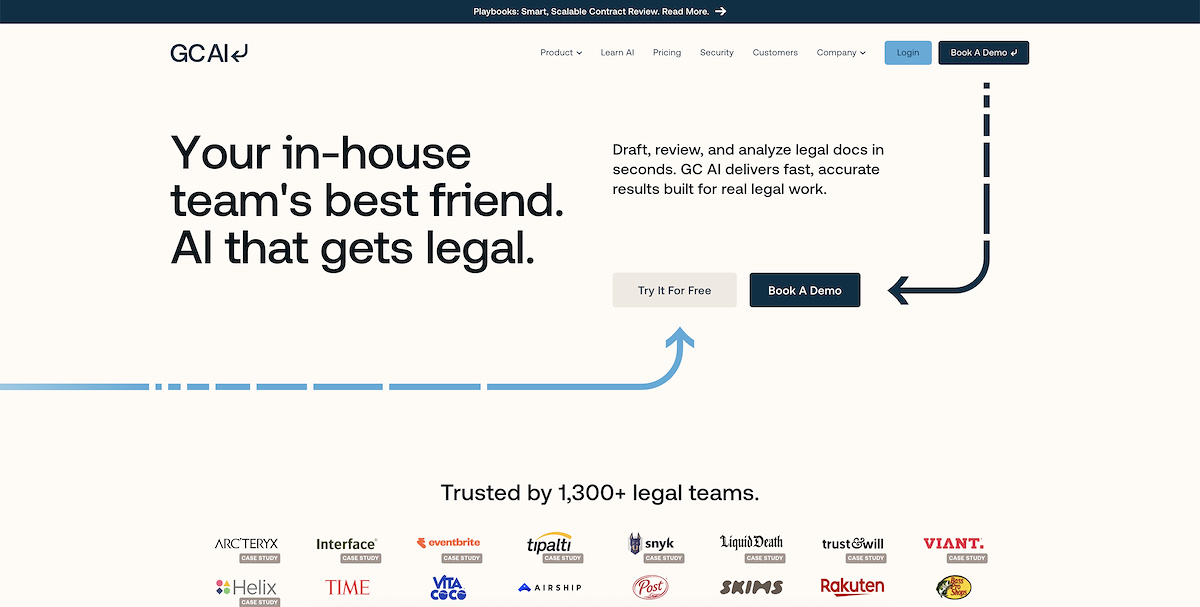
That can be relevant for an in-house lawyer who moves between different types of work during the same day, such as:
- reviewing a commercial agreement;
- researching a legal question;
- summarizing a document;
- preparing internal guidance;
- working with information from connected applications; and
- drafting or revising language.
GC AI therefore approaches the Legora comparison from the perspective of a broad in-house legal workspace rather than one specialized workflow.
It also publishes pricing for its individual plan. GC AI pricing currently lists the Individual plan at $500 per month, while team pricing is available on request. A 14-day free trial is also available.
6. Vincent by Clio: for global research and litigation intelligence
Vincent is relevant when legal research, litigation work, and international coverage are central to the use case. Vincent by Clio supports legal research, drafting, document analysis, litigation work, and multi-step agentic workflows. It can also connect directly to systems including iManage, NetDocuments, SharePoint, and Google Drive.
Its research environment is a significant part of the comparison. Vincent's own coverage spans multiple jurisdictions, while the underlying Clio Library provides access to more than one billion primary law sources, dockets, and secondary materials from more than 100 countries.
For cross-border or research-heavy teams, that legal-information foundation may be more important than whether the product and Legora share individual features such as document analysis or agents. Enterprise Vincent deployments are primarily demo-led.
How to choose a Legora alternative
A practical starting point is to identify the work consuming the most lawyer time.
- If commercial agreements dominate the workload, compare contract-focused tools such as Spellbook and LegalOn. Spellbook is centered on review, redlining, drafting, Playbooks, and negotiation context, while LegalOn emphasizes structured Playbook-driven contract review.
- If the team needs another broad enterprise legal AI platform, Harvey is a natural product to include in the evaluation. Both Harvey and Legora now span several categories of legal work, so testing representative workflows is more useful than comparing feature counts alone.
- If authoritative research is central to the decision, look closely at the source ecosystem. CoCounsel connects directly to Westlaw and Practical Law, while Vincent brings a broad international legal-research foundation through the Clio ecosystem.
- If the team is primarily in-house and the workload is varied, GC AI is worth evaluating alongside more specialized tools. A contract-heavy in-house department may also want to compare Spellbook and LegalOn.
What to compare during a Legora alternative evaluation
Once the shortlist is narrower, test each product on the same representative work.
Consider:
- Output quality: Does it identify the issues the lawyers consider important?
- Source verification: Can research and factual claims be checked easily?
- Document workflow: How much copy-pasting or reconciliation is required?
- Standards: Can the team's own Playbooks, precedents, and processes be applied?
- Multi-document work: How well does the system handle realistic document sets?
- Integrations: Does it work with Word, the document management system, and other systems the team already uses?
- Human control: Can lawyers understand, edit, reject, and verify the work before it leaves?
- Portability: Can the organization export its documents, standards, and configuration if its technology stack changes?
- Commercial structure: What seats, usage limits, implementation requirements, integrations, or other charges affect the total cost?
Using the same matters across vendors makes it easier to compare how each product fits the team's actual workflow rather than relying primarily on demonstrations or feature lists.
Test the contract workflow before committing to a broader platform
If the reason you are considering a Legora alternative is commercial contract volume, test that workflow directly before buying a broader legal AI platform. If that is the work consuming the team's time, the result will tell you more than comparing six products by feature count.
.png)
%20(1).png)
.png)
Get buy-in, compare platforms, and make AI stick.

Submission Received
Thank you for your interest!
.svg)
