
Legora vs LexisNexis: A 2026 Comparison
.jpeg)


Legora vs LexisNexis is a choice between two very different approaches to legal AI. Legora, formerly Leya, is a platform focused on scalable, structured contract review and high-volume extraction, while LexisNexis provides an AI assistant grounded in its extensive proprietary database of primary law. The two are bought differently as well: Legora sells to enterprises on a ten-seat minimum, while LexisNexis publishes small-firm tiers. Neither is built for drafting and negotiating individual agreements, which is a third category again.
Key takeaways
- Legora vs LexisNexis is not a like-for-like choice: they are grounded in different things. Legora works against your own documents, matters, and playbooks. LexisNexis works against its own authoritative library of case law, statutes, and secondary sources.
- Legora is an extraction platform; LexisNexis is a research platform. Neither substitutes for the other, and firms running both are not duplicating spend.
- Entry cost differs by an order of magnitude. LexisNexis publishes small-firm tiers from around $114 per month. Legora lists near $3,000 per seat per year on a ten-seat minimum, putting the floor around $30,000.
- LexisNexis has the citator. Shepard's is the reason most practices keep a research subscription, and Legora does not offer an equivalent.
- Legora carries European data residency, which matters for cross-border and EU-regulated work.
What is Legora?
Legora is a legal AI platform built for reviewing and extracting from large document sets. It was founded in Stockholm as Leya and rebranded to Legora in February 2025, so both names still appear in reviews and coverage.

Legora's flagship capability is Tabular Review, which runs a question across a folder of contracts and returns the answers as a structured grid, one row per document. That shape suits diligence and portfolio review: checking several hundred agreements for change-of-control provisions, or comparing a single clause across an entire contract population. It connects to iManage and SharePoint, and offers Microsoft Word and Outlook add-ins so the work happens where the documents already live.
Legora reports more than 980 customers across upward of 40 markets, with a client roster including Linklaters, Mannheimer Swartling, Bird & Bird, and Dentons. It has raised around $800 million as a private company. Where it sits against the other enterprise platforms is covered in our Legora and Harvey comparison.
Pros
- Tabular Review is genuinely effective at bulk extraction across large document sets
- Grounded in your own documents, matters, and playbooks rather than a general library
- Multi-jurisdiction coverage suits cross-border work
- European data residency, which several competitors do not offer
- Direct iManage integration plus SharePoint, Word, and Outlook surfaces
Cons
- No citator. It does not validate whether authority is still good law
- The ten-seat minimum and roughly $30,000 annual floor exclude small teams
- Large-firm deployments are reported between $5,000 and $8,000 per seat per year, well above list
- No free trial. Evaluation runs through a sales-managed pilot rather than on demand
- The value depends on you already having the documents. It does not bring a library with it
Pricing: list pricing is reported near $3,000 per seat per year with a ten-seat minimum and a minimum annual contract value around $30,000. Our Legora pricing breakdown covers the enterprise tiers and the negotiation margin buyers report.
What is LexisNexis?
LexisNexis is the legal research platform from RELX, and one of the two established providers of primary law alongside Westlaw. The value is the library: case law, statutes, regulations, and secondary sources, with editorial infrastructure built over decades.
The LexisNexis citator is Shepard's, which checks whether authority is still good law and shows how later courts have treated it. That function is the main reason practices keep a research subscription at all, and it has no equivalent in the newer AI platforms. LexisNexis also holds Moore's Federal Practice, the main alternative to Westlaw's Wright and Miller.
The LexisNexis AI layer is Protégé, sold within Lexis+ AI, which puts a conversational assistant on top of the existing research workflow rather than replacing it. How that compares against the other research incumbent is covered in our Westlaw and LexisNexis comparison.
Pros
- The authoritative library of primary law, which no workflow tool replicates
- Shepard's citator for validating whether authority still stands
- Moore's Federal Practice and a deep secondary-source collection
- Published small-firm tiers, so a practice can size a plan without a lengthy sales process
- Higher tiers bundle CourtLink and Law360 rather than charging separately
Cons
- AI is largely an add-on rather than included, and the reported range is wide
- Independent testing in 2024 found Lexis+ AI produced incorrect information more than 17% of the time, so citations still require verification
- Not built for bulk extraction across a contract portfolio, which is Legora's core strength
- Plan structure is fragmented, so matching a tier to a practice takes work
Pricing: for a firm of one to three attorneys, published rates run about $114 per month for Essential on a three-year term, $217 for Deluxe Transactional, $257 for Enhanced, and $324 for Professional with 50-state coverage. Protégé is reported at $125 to $275 per user per month as an add-on. Our LexisNexis pricing breakdown covers the tiers in full.
Legora vs LexisNexis: the core differences
What each one is grounded in
This is the difference that decides most evaluations. Legora reasons over the documents you give it: your matters, your contract population, your playbooks. LexisNexis reasons over its own library of primary law.
The consequence is that they fail in opposite directions. Ask Legora a question about controlling authority and it has no library to answer from. Ask LexisNexis to extract a provision across four hundred of your own agreements and that is not what it was built to do.
Research depth against extraction at volume
LexisNexis answers "what is the law here, and is this case still good." Legora answers "what do my four hundred contracts say about this, and where are the outliers." Both are legitimate jobs and most firms have both, which is why running the two together is common rather than wasteful. Our guide to AI legal research covers what to test in the research category specifically.
The citator gap
Shepard's is the sharpest single distinction. Validating that authority still stands is a professional-responsibility matter, not a convenience, and Legora does not offer an equivalent. A firm considering Legora as a replacement for its research subscription rather than as an addition to it should treat this as disqualifying. The same scoping question applies against a contract specialist, which our comparison of Spellbook and Legora sets out.
How each one is bought
Legora is an enterprise sale with a ten-seat minimum, no free trial, and a sales-managed pilot. LexisNexis publishes small-firm tiers that a practice can evaluate without a procurement cycle. This determines who can even run an evaluation: a four-person firm can price LexisNexis this afternoon and cannot buy Legora at all.
How much do Legora and LexisNexis cost?
| Legora | LexisNexis | |
|---|---|---|
| Entry cost | ~$3,000 per seat per year | ~$114 per month, Essential, small firm |
| Higher tiers | $5,000 to $8,000 per seat per year reported at large-firm scale | $217 to $324 per month, up to 50-state coverage |
| AI layer | Included in the platform | Protégé reported at $125 to $275 per user per month as an add-on |
| Seat minimum | 10 seats | None published |
| Minimum annual spend | ~$30,000 | None published |
| Free trial | None; sales-managed pilot | Limited, varies by plan |
| Citator | None | Shepard's |
| European data residency | Yes | Varies by contract |
Figures come from published rates and third-party reporting and vary by term, jurisdiction, and negotiation. Confirm current pricing with each vendor.
Two points matter more than the headline rates.
The comparison is not like for like
LexisNexis at $114 per month buys a research library for one attorney. Legora at $3,000 per seat buys an extraction platform that brings no library with it. A firm comparing those two numbers as though they were substitutes will reach the wrong conclusion in either direction.
What sits outside the subscription differs too:
- Legora: implementation and integration work for iManage or SharePoint, plus the seats committed but not filled under the minimum
- LexisNexis: jurisdiction expansion, which is the most common mid-term increase, and Protégé as a separate line item
- Both: multi-year terms that lower the monthly rate while reducing leverage at renewal
- Both: the internal owner who keeps playbooks or research standards current, which no quote includes
The floor decides small evaluations
Legora's ten-seat minimum means the entry cost is roughly $30,000 a year regardless of how many people use it, so for a team of four the effective per-user cost more than doubles. LexisNexis has no published minimum. For teams priced out of Legora, our Legora alternatives guide covers the wider field.
Which should you choose?
Choose LexisNexis if
The work is finding and validating law. If the recurring task is researching an issue, checking whether a case still stands, or citing authority in a filing, that is the research category and Legora does not compete in it. This is also the choice for any practice too small to clear a ten-seat commitment.
Choose Legora if
The work is reviewing or extracting across a large document set. Diligence, portfolio review, and multi-jurisdiction contract analysis are what Tabular Review is built for, and no amount of research depth substitutes for structured extraction across hundreds of agreements. Our Legora and CoCounsel comparison covers how it fares against a research-led platform.
Firms often need both
These are complementary rather than competing purchases for a firm doing both litigation and transactional work. The budget question is which bottleneck is currently costing more, not which platform wins. Teams weighing the enterprise AI tier alongside a research subscription may find our Harvey and LexisNexis comparison useful.
If the bottleneck is drafting rather than research or review
Neither platform is built for producing and negotiating individual agreements. A team whose real constraint is turning a template into a signed contract is in a third category, covered in our comparison of Spellbook and LexisNexis. Buying an extraction platform or a research library will not shorten a negotiation, and teams often discover that only after a full procurement cycle.
See where your positions sit against the market
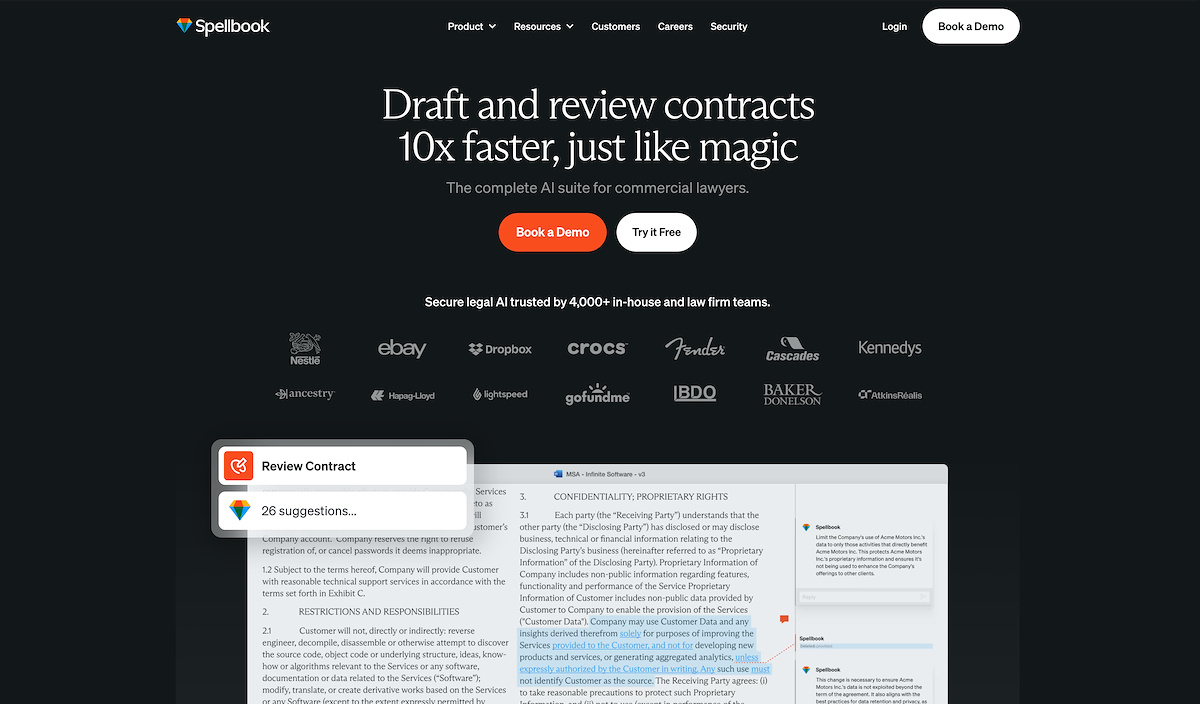
Extraction tells you what your contracts say. It does not tell you whether those positions are reasonable. Spellbook benchmarks clause positions against aggregated market data, so a reviewer can see whether a term sits inside or outside the range being agreed rather than only how often it appears in your own paper.
Frequently asked questions
Is Legora better than LexisNexis?
The short answer to Legora vs LexisNexis is that neither wins outright. Neither is better, because they do different jobs. LexisNexis provides an authoritative library of primary law with a citator; Legora provides structured extraction across your own documents. A firm choosing between them on quality is usually asking the wrong question, and a firm that needs both should budget for both.
How much does a Legora subscription cost?
Legora list pricing is reported near $3,000 per seat per year with a ten-seat minimum, which puts the minimum annual contract value around $30,000. Large-firm deployments are reported between $5,000 and $8,000 per seat per year. There is no free trial; evaluation runs through a sales-managed pilot.
Who owns Legora, and is Legora the same as Leya?
Legora is a privately held company founded in Stockholm as Leya, rebranded to Legora in February 2025. It is venture-backed, having raised around $800 million, and is not owned by a legal publisher, which distinguishes it from LexisNexis and from Thomson Reuters-owned products.
Which law firms are using Legora?
Legora reports more than 980 customers across upward of 40 markets, with a publicly named roster including Linklaters, Mannheimer Swartling, Bird & Bird, and Dentons. The concentration skews toward large international and European firms, which is consistent with its enterprise pricing and seat minimum.
Does Legora replace a legal research subscription?
No. Legora has no citator and no library of primary law, so it cannot validate whether authority is still good law. Firms adopting Legora generally keep a research subscription alongside it rather than switching. Our overview of legal AI tools maps how the categories divide.
Why do people compare Legora with Harvey more often than with LexisNexis?
Legora and Harvey compete in the same category, as enterprise AI platforms sold on workflow and extraction, so they appear on the same shortlists. LexisNexis competes in the research category, which is why a Legora and LexisNexis comparison is usually about whether the two are complementary rather than which one wins.
Which is more accurate for legal research?
LexisNexis, because it is grounded in an authoritative library and Legora is not built for that task. That said, independent testing in 2024 found Lexis+ AI produced incorrect information more than 17% of the time, so output from either platform requires verification before it is relied on. Our guide to AI legal document review covers where verification matters most.
How we compared these platforms
Both platforms were assessed on the same five dimensions: what each one is grounded in, the tasks each is built for, published or credibly reported pricing at comparable settings, how each is bought including seat minimums and trial availability, and how each handles client data including residency.
Pricing was taken from published vendor rates where they exist and from third-party reporting where they do not, and labeled accordingly. Neither vendor publishes a complete rate card, so figures vary by term, jurisdiction, and negotiation. The AI accuracy figure comes from a 2024 academic study that tested products both vendors have since updated, and is reported here with that limitation stated. Confirm current pricing and capability with each vendor before deciding. Teams reconsidering the research subscription itself, rather than choosing between these two, should start with our LexisNexis alternatives guide.
.png)
%20(1).png)
.png)
Get buy-in, compare platforms, and make AI stick.

Submission Received
Thank you for your interest!
.svg)
