
Spellbook vs Legora: Which Should You Choose in 2026?
.jpeg)

Spellbook and Legora solve different problems. Spellbook is built for drafting, reviewing, and negotiating individual agreements, grounded in aggregated market data. Legora, formerly Leya, is built for portfolio-scale review, extraction, and multi-jurisdictional research across large document sets.
Key takeaways
- The decision is a scope question rather than a quality question. Spellbook is built around the individual agreement. Legora is built around the portfolio.
- Spellbook uses custom per-seat pricing based on team size, with no seat minimum and a free seven-day trial. Legora lists near $3,000 per seat per year on a ten-seat minimum, which puts the annual floor around $30,000, and offers no free trial.
- Legora carries European data residency. Spellbook does not. For teams with a hard EU data-residency requirement, that single line can decide the evaluation before anything else is compared.
- Legora is the stronger fit for large, cross-border diligence and portfolio review. Spellbook is the stronger fit for teams whose volume is drafting and negotiating commercial agreements one at a time.
What is Legora?
Legora is a legal AI platform for large-scale document review and research. It was founded in Stockholm as Leya and rebranded to Legora in February 2025, so buyers researching the product will still find both names in circulation.

Legora's flagship capability is Tabular Review, which extracts structured answers across a large set of documents and presents them as a table, one row per document. That shape suits diligence: reviewing several hundred agreements for change-of-control provisions, or comparing a clause across a portfolio. Legora connects to iManage, the document management system common in larger firms, through a direct API integration and also supports SharePoint and single sign-on, which is how it fits into the document stack larger firms already run.
The customer base reflects that positioning. Legora reports more than 980 customers across upward of 40 markets, with a client roster including Linklaters, Mannheimer Swartling, Bird & Bird, and Dentons, and it has raised around $800 million. That multi-jurisdictional coverage is a genuine strength for cross-border work, and it is one of the few platforms in this category to offer European data residency. Closer peers on the review side are covered in our Legora and Ivo comparison.
Pros
- Tabular Review handles bulk extraction across large document sets effectively
- Multi-jurisdictional coverage suits cross-border and European work
- European data residency, which several competitors do not offer
- Direct iManage API integration, plus SharePoint and single sign-on support
- Established with large international firms, so the enterprise deployment path is well worn
Cons
- The ten-seat minimum and roughly $30,000 annual floor rule out small teams entirely
- Large-firm deployments are reported between $5,000 and $8,000 per seat per year, well above list
- No free trial. Evaluation runs through a sales-managed pilot rather than on demand
- Portfolio-scale breadth is of limited use to teams negotiating agreements one at a time
Pricing: list pricing is reported near $3,000 per seat per year, with a ten-seat minimum and a minimum annual contract value around $30,000. Our Legora pricing breakdown covers the enterprise tiers and the negotiation margin buyers report.
What is Spellbook?
Spellbook is an AI suite for commercial lawyers, built for the work that happens once the research is done: drafting agreements, reviewing incoming paper, redlining against a position, and negotiating through to signature.
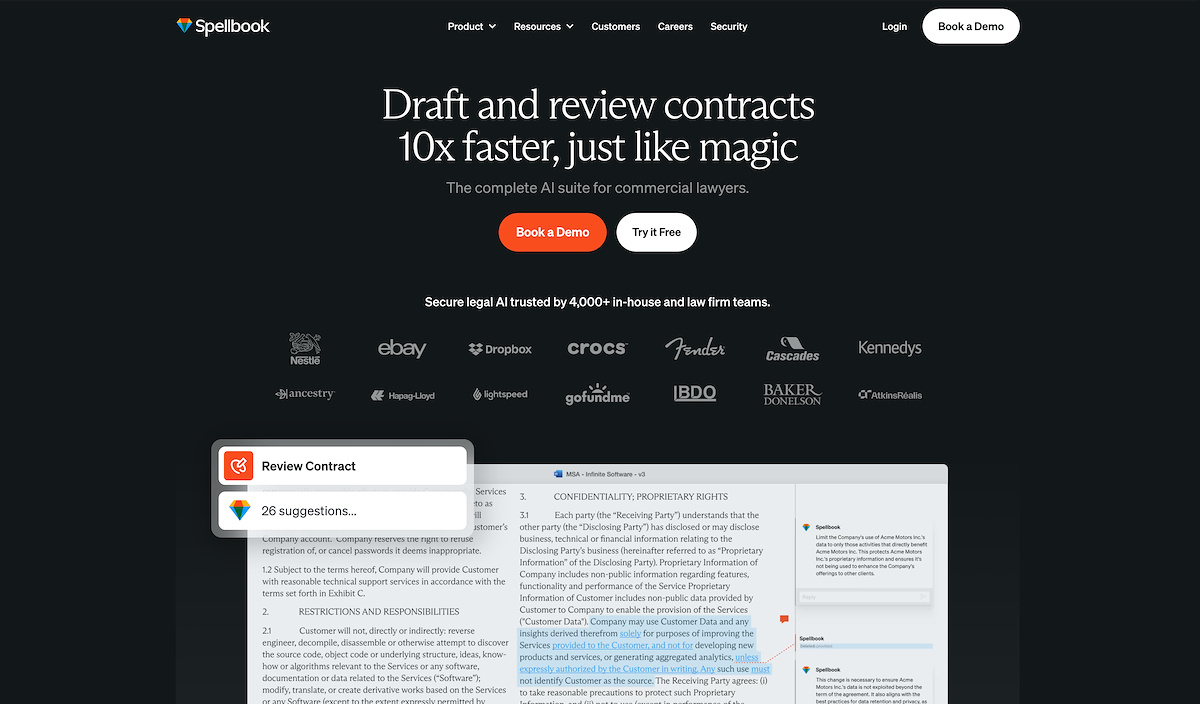
Spellbook's distinguishing capability is market benchmarking. Rather than checking a clause only against a team's own playbook, Spellbook compares positions across more than 270 clause types drawn from over 20 million processed contracts, alongside more than 2,300 defined benchmark standards. A reviewer can see whether a term sits inside or outside the range that is actually being agreed, which is a different question from whether it matches the template. The contract review process guide covers how playbook-led and market-led review differ.
It sells single seats, bills per seat annually with volume discounts above ten seats, and offers a seven-day trial, so a team can evaluate it without a procurement cycle.
Pros
- Built specifically for drafting, review, redlining, and negotiation rather than bulk extraction
- Clause positions benchmarked against aggregated market data, not only internal precedent
- No seat minimum, so a small team or a single practitioner can buy
- Seven-day free trial, which most platforms in this category do not offer
- Runs in the drafting environment lawyers already use, so adoption does not require a new workflow
Cons
- No European data residency. For teams with an EU residency requirement, this is disqualifying
- Not a legal research platform. Teams needing primary law and citation validation still need a research subscription
- Portfolio-wide extraction across hundreds of documents is not the design target, so Legora does that job better
- Pricing is custom rather than published, so budgeting requires a conversation with sales
Pricing: custom per seat, based on the number of team members, billed annually, with no seat minimum and volume discounts above ten seats. A seven-day free trial is available.
What are the main differences between Spellbook and Legora?
Scope: the agreement or the portfolio
This is the difference that decides most evaluations. Legora is built to help a team answer the same question across a set of documents, which is what diligence and portfolio review require. Spellbook is built for the agreement in front of you, which is what drafting and negotiation require. A team doing both will feel the gap in whichever direction it did not buy for. Our overview of legal AI tools maps where each category sits.
What each one is grounded in
Legora grounds its answers in the documents you give it, plus its research coverage across jurisdictions. Spellbook grounds review in aggregated market data, so the reference point is what other parties are agreeing rather than only what your own precedent says. For a negotiation, that changes the argument available: a position can be defended as market rather than merely as policy. Teams building internal standards alongside that will find our contract negotiation playbook guide useful.
How each one is bought
Legora is an enterprise sale with a ten-seat minimum, no trial, and a sales-managed pilot. Spellbook is a single-seat purchase with a seven-day trial. This difference matters more than it first appears, because it determines who can run an evaluation at all. A five-person in-house team can trial Spellbook this week. The same team cannot buy Legora. Teams that also need case law research alongside contract work should read our Spellbook and CoCounsel comparison, since that is the gap a contract specialist does not fill.
Where the data sits
Legora offers European data residency. Spellbook does not. Teams operating under an EU data-residency requirement should treat this as a gating criterion rather than a feature comparison, because it is the kind of requirement that ends an evaluation regardless of how the rest of the comparison reads.
How much do Spellbook and Legora cost?
| Spellbook | Legora | |
|---|---|---|
| Cost per seat per year | Custom per-seat pricing | ~$3,000 list; $5,000 to $8,000 reported at large-firm scale |
| Seat minimum | None | 10 seats |
| Minimum annual spend | None published | ~$30,000 |
| Free trial | 7 days | None; sales-managed pilot |
| European data residency | No | Yes |
| Primary use case | Contract drafting, review, and negotiation | Portfolio review, diligence, and legal research |
Figures are estimates drawn from published rates and third-party reporting, and quote-based pricing varies by scope. Confirm current numbers with each vendor before deciding.
Three points matter more than the headline rate.
The floor, not the rate, decides small evaluations
Legora's ten-seat minimum means the entry cost is roughly $30,000 a year regardless of how many people will actually use it. For a team of four, the effective per-user cost is more than double the list rate. Spellbook has no minimum, so a team of four pays for four seats. For the wider category, our Harvey pricing breakdown shows where both sit against the enterprise tier.
Neither list price is what a large deployment pays
- Legora is reported between $5,000 and $8,000 per seat per year at large-firm scale, well above its own list rate
- Buyers report meaningful negotiation margin on Legora enterprise contracts, so the first quote is rarely the last
- Spellbook applies volume discounts above ten seats
- Legora pricing varies by European market, so a quote in one country does not predict another
Comparing list prices alone will mislead in both directions.
Count the costs that sit outside the subscription
- Implementation and integration work, which Legora's iManage and SharePoint connections typically involve
- Data processing agreement negotiation and ongoing compliance review, heavier where residency is in scope
- Training time, and the internal owner who keeps playbooks or standards current
- The seats you commit to but do not fill, which is where a seat minimum quietly costs the most
Which should you choose, Spellbook or Legora?
Choose Legora if
The work is diligence, portfolio review, or cross-border research. Our Legora and CoCounsel breakdown covers how it compares against a research-led platform. If a typical task is answering the same question across two hundred agreements, Tabular Review is built for exactly that, and no amount of per-document speed substitutes for it. Legora is also the choice where European data residency is a requirement, and where the team is large enough that a ten-seat commitment is not a constraint.
Choose Spellbook if
The work is producing and negotiating agreements. If the bottleneck is turning a template into a signed contract, arguing a position with a counterparty, or reviewing incoming paper at volume, that is what Spellbook is built for. It is also the practical choice for any team below ten seats, because Legora is not purchasable at that size. Teams evaluating the broader field can start with our Legora alternatives guide.
If the work is genuinely both
Larger firms often run a research and diligence platform alongside a contract specialist, because the two jobs pull in different directions. If that is the situation, the sequencing question is which bottleneck costs more right now, and the answer is usually whichever one is currently absorbing associate hours that could be billed elsewhere.
Running both also raises a question most evaluations skip: where the clause library lives. If drafting standards sit in one platform and portfolio review runs in the other, the two will drift apart unless somebody owns keeping them aligned. Teams weighing a research platform alongside a contract tool may find our comparison of Legora and Harvey useful.
What to test before you commit
Evaluations of both platforms tend to test the demo path rather than the real one. A more useful trial checks:
- Your own documents, not the vendor's samples, including the messy ones with tracked changes already in them
- A clause your team actually argues about, to see whether the tool's position is defensible to a counterparty
- What happens on a document type outside the core use case, since that is where the difference between the two shows up fastest
- How output survives the round trip back into the format you send to the other side
- Who on the team can operate it without training, because adoption stalls where only one person can drive it
- The security and data questions in writing, including residency, retention, and whether client material is used for training
Put a first-pass review in front of every contract
Most review time goes on the same checks repeated across every agreement. Spellbook runs a first-pass review against your positions and surfaces what needs a lawyer's attention, so the reading time goes to the clauses that actually carry risk.
Frequently asked questions
How is Spellbook priced?
Spellbook uses custom per-seat pricing based on the number of team members on a license, so there is no published monthly or annual rate. There is no seat minimum, volume discounts apply above ten seats, and a free seven-day trial is available.
How much is a Legora subscription?
Legora list pricing is reported near $3,000 per seat per year with a ten-seat minimum, which puts the minimum annual contract value around $30,000. Large-firm deployments are reported between $5,000 and $8,000 per seat per year. There is no free trial.
Is Legora the same as Leya?
Yes. Legora was founded in Stockholm as Leya and rebranded in February 2025. Both names still appear in reviews and coverage, so a search for either will return material about the same product.
Which is better for legal drafting?
Spellbook is the closer fit for drafting, because it is built around producing and negotiating individual agreements and benchmarks clause positions against aggregated market data. Legora's strength is answering questions across large document sets, which is a different task. For a wider view of drafting tools, see our guide to AI legal document review.
Does either one offer a free trial?
Spellbook offers a seven-day free trial that can be started without a sales conversation. Legora does not offer a free trial; evaluation runs through a sales-managed pilot arranged with its team.
Can Spellbook and Legora be used together?
Yes, and larger firms sometimes do. The two cover different stages, so a firm may run Legora for diligence and portfolio review while contract teams use Spellbook for drafting and negotiation. The main considerations are cost duplication and where the clause library sits, which our clause library guide covers.
Which one is better for legal research?
Neither is primarily a legal research platform in the sense of primary law and citation validation, though Legora covers research across jurisdictions more broadly than Spellbook does. Teams whose main requirement is case law research should look at that category directly, starting with our guide to AI legal research.
Where do these sit against the wider market?
Both compete in a category that also includes research-led platforms and full contract lifecycle management systems. Legora sits nearer the research and diligence end of that range, and Spellbook nearer the drafting and negotiation end, with several vendors occupying the ground between them. Our Legora and LexisNexis comparison covers the research end specifically.
How we compared these tools
Both platforms were assessed on the same five dimensions: the work each is built for, how each is bought including seat minimums and trial availability, published or credibly reported pricing at a consistent setting, integration with the document stack a team already runs, and how each handles client data including residency.
Pricing was taken from published rates and third-party reporting, and labelled accordingly. Neither vendor publishes a full rate card, so figures are estimates rather than quotes, and enterprise pricing in this category carries meaningful negotiation margin. Rates change. Confirm current figures with each vendor before making a decision.
.png)
%20(1).png)
.png)
Get buy-in, compare platforms, and make AI stick.

Submission Received
Thank you for your interest!
.svg)
