
Westlaw vs LexisNexis: A 2026 Comparison
.jpeg)


Westlaw and LexisNexis are the two established legal research platforms, and the practical difference comes down to three things: the citator, the exclusive treatises, and the AI layer. Westlaw runs KeyCite and the Key Number System. LexisNexis runs Shepard's and the Protégé assistant. For teams whose real work is commercial contracts rather than case law, a third question matters more than either: how much research capability you are actually buying for an in-house function.
Key takeaways
- The Westlaw vs LexisNexis choice rarely turns on case law coverage, because both platforms cover the primary law most practices need. The choice usually turns on the citator your team already knows, the treatises your practice area depends on, and price.
- Entry pricing is closer than reputation suggests. Westlaw Edge starts around $107.25 per month and the LexisNexis Essential plan around $114 per month for a small firm, both on multi-year terms. The gap widens at the AI and all-jurisdiction tiers.
- KeyCite and Shepard's are the real switching cost. Both do the same job. Neither is meaningfully better, and lawyers are fast in whichever they trained on.
- On AI, independent testing in 2024 found meaningful error rates in both platforms' research assistants, with Westlaw's product performing worse on that measure. Both vendors have shipped newer AI since, and neither has published comparable independent results.
What is Westlaw?
Westlaw is Thomson Reuters' legal research platform. Westlaw's defining asset is the Key Number System, a human-curated taxonomy that classifies American case law by legal issue, built and maintained by editors over more than a century. For a researcher who knows the taxonomy, it is a fast way to move from one relevant case to every case addressing the same point. Our CoCounsel alternatives guide covers the assistants now competing with that workflow.
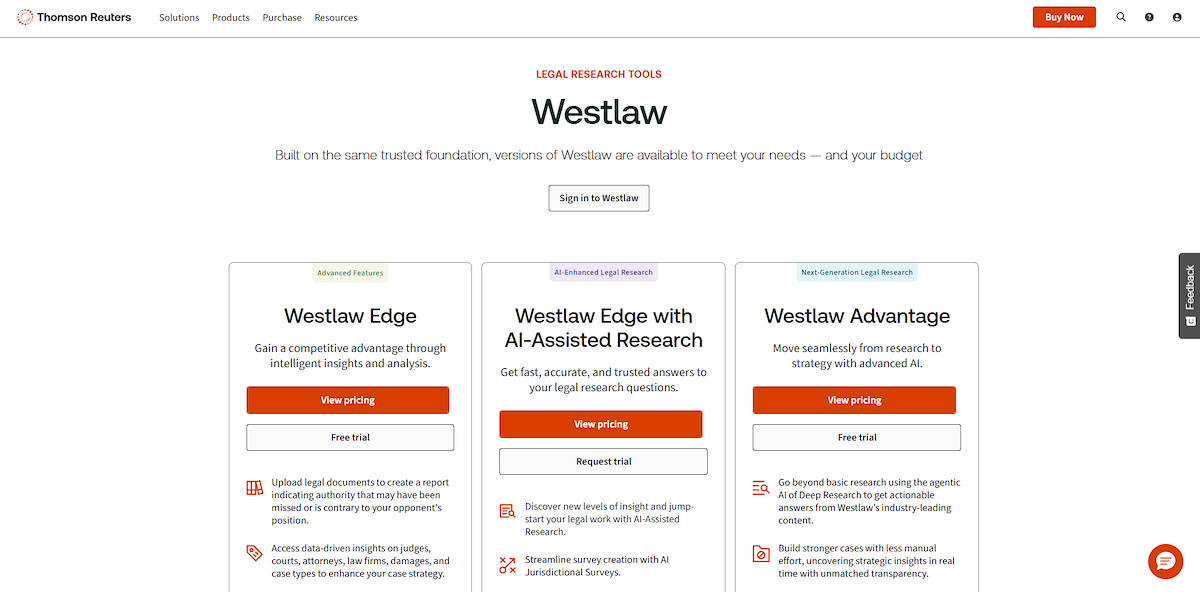
The Westlaw citator is KeyCite, which flags whether a case is still good law and tracks negative treatment. Westlaw's exclusive treatise holdings include Wright and Miller's Federal Practice and Procedure, which for federal civil procedure work is close to a requirement rather than a preference.
On the AI side, Westlaw Advantage adds Deep Research, a Litigation Document Analyzer, and CoCounsel Legal, the agentic assistant Thomson Reuters built from its Casetext acquisition. Our CoCounsel pricing guide covers how those tiers are bundled.
Pros
- The Key Number System has no direct equivalent, and it is genuinely fast for issue-based research
- KeyCite is well understood and thoroughly integrated into the research flow
- Exclusive federal practice treatises, including Wright and Miller
- Natural-language search performs well, which lowers the training burden for newer researchers
- Seven-day trial available on published tiers
Cons
- The all-jurisdiction tiers rise steeply, reaching around $399.75 per month for all states plus federal on Westlaw Advantage
- Out-of-plan charges apply on some subscriptions, so the invoice can exceed the quoted rate
- Independent 2024 testing found a higher error rate in its AI research product than in the LexisNexis equivalent
- Pricing is quote-driven above the published tiers, which makes budgeting harder
Pricing: published rates start around $107.25 per month for Westlaw Edge on a single circuit, $155.35 per month for Edge with AI-Assisted Research on a three-year term, and $256.75 to $399.75 per month for Westlaw Advantage depending on jurisdiction coverage. Our Westlaw pricing breakdown sets out the tiers and the out-of-plan charges.
What is LexisNexis?
LexisNexis is the research platform from RELX, and the closest thing the market has to a like-for-like Westlaw substitute. Coverage of primary law is comparable, and for most practices the decision is not about whether the case is there.
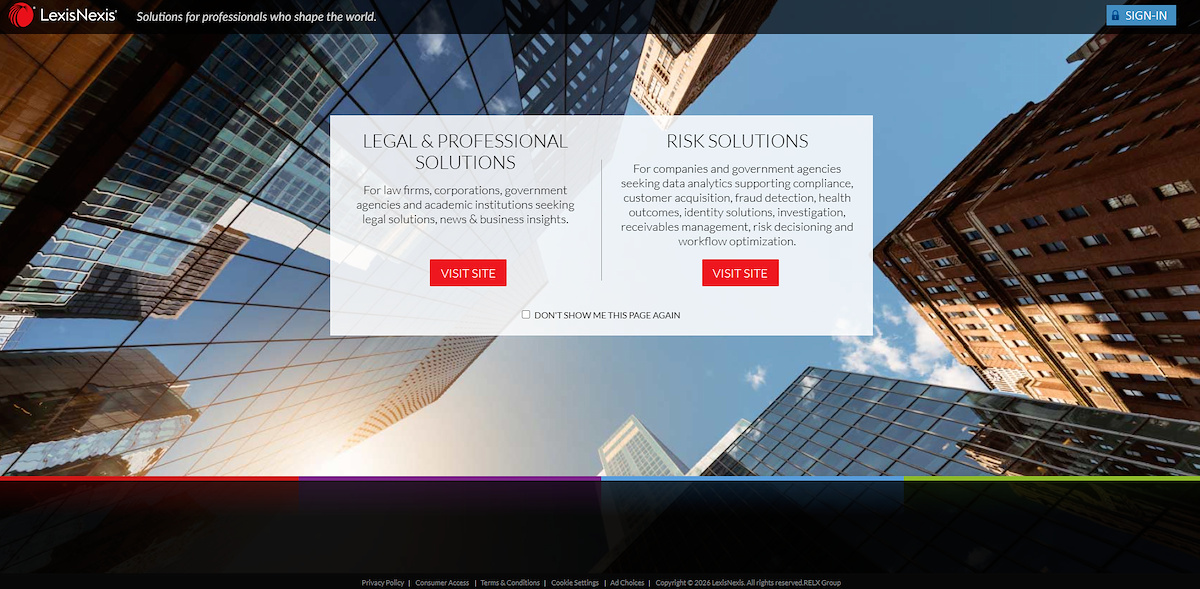
The LexisNexis citator is Shepard's, which predates electronic research entirely and remains the reference point many litigators were trained on. Shepard's is often described as giving deeper historical treatment, while KeyCite is described as cleaner for current negative treatment. In practice both answer the question a lawyer is asking.
LexisNexis holds Moore's Federal Practice, the main alternative to Wright and Miller, and its AI layer is Protégé, sold within Lexis+ AI. Practices that also want litigation analytics get CourtLink and Law360 at the higher tiers. Our Legora and LexisNexis comparison covers how a newer entrant stacks up against that bundle.
Pros
- Shepard's is the citator many litigators trained on, and switching has a real learning cost
- Strong exploratory search and precise Boolean logic, which suits researchers who want control over the query
- Moore's Federal Practice for federal civil procedure work
- Higher tiers bundle CourtLink and Law360 rather than charging separately
- Independent 2024 testing found a lower error rate in Lexis+ AI than in the Westlaw product tested
Cons
- Plan structure is more fragmented, so matching a tier to a practice takes more work
- AI is largely an add-on rather than included, and the reported add-on range is wide
- Reported AI pricing spans $125 to $275 per user per month on top of a base plan, which makes total cost harder to predict
- The same 2024 testing still found incorrect information in more than 17% of responses, so verification remains mandatory
Pricing: for a firm of one to three attorneys, published rates run about $114 per month for Essential on a three-year term, $217 for Deluxe Transactional, $257 for Enhanced, and $324 for Professional with 50-state coverage. Protégé is reported at $125 to $275 per user per month as an add-on. Our LexisNexis pricing breakdown covers the tiers in full.
Westlaw vs LexisNexis: the core differences
Citators: KeyCite against Shepard's
This is the difference lawyers argue about and the one that decides the fewest evaluations on merit. Both citators answer whether a case is still good law and who has treated it since. Shepard's is generally described as offering deeper historical treatment; KeyCite is generally described as presenting current negative treatment more cleanly.
The honest position is that neither is clearly better, and the real cost is retraining. A litigator who has used Shepard's for fifteen years will be slower in KeyCite for months, and that lost time is a larger number than the price difference between the platforms. Newer entrants generally do not offer a citator at all, which our LexisNexis and Ivo comparison illustrates.
Editorial system and search style
Westlaw's Key Number System is a curated classification of case law by legal issue. There is no true equivalent on LexisNexis, and for researchers who work by issue rather than by keyword it is the single strongest argument for Westlaw.
LexisNexis tends to reward precise Boolean construction and exploratory searching. Neither approach is superior; they suit different habits. Teams evaluating both should have the same researcher run the same three real queries on each and compare what comes back. Our LexisNexis and LegalOn comparison shows how differently a review-focused tool approaches the same document.
Exclusive treatises
Westlaw holds Wright and Miller's Federal Practice and Procedure. LexisNexis holds Moore's Federal Practice. For federal civil procedure work these are the two standard references, and a practice that depends on one of them has had its decision made for it. This is worth checking before any pricing conversation, because it is the one difference that cannot be negotiated around.
AI: CoCounsel against Protégé
Westlaw's AI arrives through Westlaw Advantage as Deep Research and CoCounsel Legal. LexisNexis offers Protégé within Lexis+ AI. Both are retrieval-based assistants grounded in the vendor's own library, and both are sold as reducing research time rather than replacing the researcher.
Because the two libraries differ, the assistants inherit those differences. A question that depends on a Wright and Miller passage will go better on Westlaw regardless of which assistant is stronger. The guide to AI legal research covers what to test during a trial.
How much do Westlaw and LexisNexis cost?
Neither vendor publishes a full rate card, and both quote by firm size, jurisdiction, and term. The published and reported figures below use small-firm settings on multi-year terms.
| Westlaw | LexisNexis | |
|---|---|---|
| Entry tier | Westlaw Edge, ~$107.25/month, single circuit | Essential, ~$114/month, single state |
| Mid tier | Edge with AI-Assisted Research, ~$155.35/month (3-year) | Enhanced ~$257/month; Deluxe Transactional ~$217/month |
| Top published tier | Westlaw Advantage, ~$256.75 single circuit to ~$399.75 all states plus federal | Professional, ~$324/month, 50-state with CourtLink and Law360 |
| AI | Included in Advantage (Deep Research, CoCounsel Legal) | Protégé reported at $125 to $275/user/month as an add-on |
| Citator | KeyCite | Shepard's |
| Free trial | 7 days on published tiers | Limited; varies by plan |
Figures are drawn from published rates and third-party reporting and vary by term, jurisdiction, and negotiation. Confirm current pricing with each vendor.
Three things matter more than the headline rate.
The entry gap is smaller than the reputation
Westlaw Edge at about $107.25 and LexisNexis Essential at about $114 are close enough that price should not decide the entry-level choice. The gap opens further up, where Westlaw Advantage bundles the AI layer into the subscription while LexisNexis largely sells Protégé as an add-on. Comparing a Westlaw AI tier against a LexisNexis base tier will make LexisNexis look cheaper than it is in practice. Assistants built on other libraries price differently again, which our CoCounsel and Vincent AI breakdown sets out.
Watch the charges outside the subscription
- Out-of-plan usage on some Westlaw subscriptions, which appears after the fact rather than in the quote
- Jurisdiction expansion, which is the most common mid-term cost increase on both platforms
- AI as a separate line item on LexisNexis, which is easy to omit from a first comparison
- Multi-year terms, which lower the monthly rate but reduce leverage at renewal
Seats you do not use are the largest hidden cost
Research platforms are usually bought firm-wide and used unevenly. Before renewing either, pull actual usage by seat. On transactional and in-house teams especially, the finding is often that a minority of seats accounts for most of the research, and the rest are paying full price for occasional lookups. Enterprise AI platforms are priced well above both, as our Harvey pricing breakdown shows.
Which platform's AI is more reliable?
This is the question the market asks most and answers worst, so it is worth being precise about what has actually been measured.
In May 2024, Stanford's RegLab published a preprint titled Hallucination-Free? Assessing the Reliability of Leading AI Legal Research Tools, testing the vendors' research assistants against a pre-registered set of more than 200 open-ended legal queries. It found that Lexis+ AI and Ask Practical Law AI produced incorrect information more than 17% of the time, while Westlaw's AI-Assisted Research hallucinated more than 34% of the time. For context, an earlier study found general-purpose chatbots produced incorrect legal information between 58% and 82% of the time, so the retrieval-grounded legal tools were a substantial improvement over general models while still being wrong often.
Two qualifications matter, and most summaries of this study omit both.
- Scope. The study tested Westlaw's AI-Assisted Research and Lexis+ AI as they existed in early 2024. Thomson Reuters has since shipped Westlaw Advantage with Deep Research and CoCounsel Legal, and LexisNexis has shipped Protégé. The finding measures the 2024 products, not what either vendor sells today
- No follow-up. Neither vendor has published comparable independent evaluation results since, so there is no current equivalent to cite
- Opacity was the durable point. The tools provide little systematic access and report no evaluation results of their own, which is why an academic group had to build the benchmark rather than review a published one
What the study does support, and what it does not:
- It supports the claim that retrieval-grounded legal tools were substantially more reliable than general chatbots in 2024
- It supports the claim that both platforms returned incorrect information often enough to require checking every citation
- It does not support a claim about which vendor's current assistant is more accurate
- It does not measure usefulness, speed, or research time saved, only correctness on a fixed query set
The practical conclusion has not changed. Citations from either platform's assistant require verification before they go in a filing, and any workflow that treats AI research output as final is unsafe on both. Our overview of legal AI tools covers how these assistants differ from general models.
Which should you choose?
Check these four things before comparing features
Most evaluations get decided by one of these rather than by a feature list:
- Which treatise the practice actually relies on, since Wright and Miller and Moore's sit on opposite platforms
- Which citator the senior researchers trained on, because retraining costs more than the price difference
- The jurisdictions genuinely needed, since all-states coverage is the single largest price step on both
- Current usage by seat on any existing subscription, which is usually lower and more concentrated than expected
For litigation and research-heavy practices
Start with the treatise and the citator. If the practice depends on Wright and Miller, or the litigators are fluent in KeyCite, Westlaw is the lower-friction choice. If it depends on Moore's, or the team trained on Shepard's, LexisNexis is. These two factors decide more evaluations correctly than any feature comparison will.
For solo practitioners and small firms
Compare the entry tiers directly, because they are close, and be precise about jurisdiction coverage. A single-state or single-circuit plan is considerably cheaper than all-states coverage, and many small practices buy broader coverage than their matters require. Teams that find both too expensive for their volume should look at the wider field, which our LexisNexis alternatives guide covers.
For in-house and transactional teams
This is where the honest answer diverges from the question. Both platforms are built for researching law. An in-house commercial team's bottleneck is usually not finding the law but producing and negotiating agreements, and a research subscription does not help with that work.
Teams in that position often end up paying for full research seats that get used a few times a month, while the contract review queue stays manual. The useful exercise is to separate the two needs: keep a smaller research footprint sized to actual usage, and address contract throughput with tooling built for it. The comparison of Spellbook and LexisNexis sets out where the categories separate.
The practical version of this is a usage audit before renewal. Pull the number of research sessions per seat over a quarter, separate the people running genuine case law research from the people occasionally checking a definition, and size the subscription to the first group. The saving is usually enough to fund contract tooling outright, and our contract review process guide covers what that work involves.
If you are weighing the newer AI-first platforms
Several entrants now compete with parts of what Westlaw and LexisNexis do, generally by pairing a different library with a newer assistant. They tend to win on interface and speed and lose on citator depth and treatise coverage, which is the trade most practices are actually making. Our Harvey and LexisNexis comparison covers one of them in detail.
Where contract work fits alongside research
Research platforms answer questions about the law. They are not built to draft an agreement, redline incoming paper, or hold a negotiating position across a deal. Spellbook is built for that second job, and it benchmarks clause positions against aggregated market data so a reviewer can see whether a term sits inside or outside the range being agreed. It does not replace a research subscription, and teams that need primary law and citation validation will still need one.
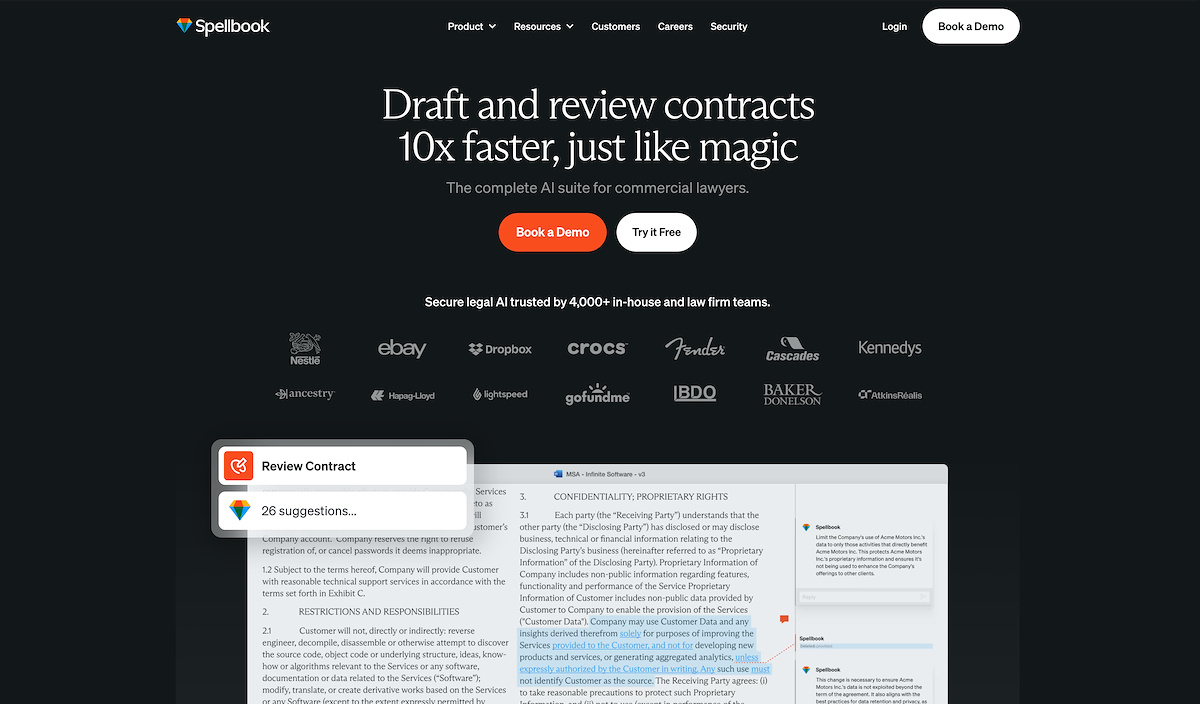
The division of labour is usually clean:
- Case law research, citator validation, and treatise work stay on Westlaw or LexisNexis
- Drafting agreements, reviewing incoming paper, and holding a position through negotiation sit with contract tooling
- Matter-specific questions that depend on primary law belong to the research platform regardless of which contract tool is in place
Frequently asked questions
Is Westlaw better than LexisNexis?
Neither is better across the board. Westlaw has the Key Number System and Wright and Miller; LexisNexis has Shepard's and Moore's Federal Practice. Coverage of primary law is comparable, so the decision usually turns on which citator the team knows and which treatises the practice depends on.
Who has better AI, Lexis or Westlaw?
On the main independent test published to date, Lexis+ AI performed better: Stanford RegLab's 2024 study found it produced incorrect information more than 17% of the time against more than 34% for Westlaw's AI-Assisted Research. That measured the 2024 products, and both vendors have shipped newer assistants since without comparable published results, so it should be treated as a historical finding rather than a current verdict.
How much do Westlaw and LexisNexis cost per month?
Published small-firm rates start around $107.25 per month for Westlaw Edge and around $114 per month for LexisNexis Essential, both on multi-year terms. Higher tiers run to roughly $399.75 per month for Westlaw Advantage with all-states coverage and roughly $324 per month for LexisNexis Professional, with Protégé reported at $125 to $275 per user per month on top.
Are Westlaw and LexisNexis free, and can the public use them?
Neither is free, and neither is generally available to the public. Access usually comes through a firm, a law school, or a public law library, and many county law libraries provide free on-site access. Free sources such as CourtListener and Google Scholar cover a good deal of case law but do not include the citators or the treatises.
Is there a free alternative to Westlaw?
For case law alone there are usable free sources, but they do not replace KeyCite or Shepard's, and citator coverage is the reason most practices pay. Treat free tools as a supplement for initial research rather than as a substitute where the validity of a citation matters.
What is the difference between KeyCite and Shepard's?
Both check whether authority is still good law and show how later courts have treated it. Shepard's is generally regarded as giving deeper historical treatment and KeyCite as presenting current negative treatment more cleanly. The practical difference for most researchers is familiarity rather than capability.
Can a contract tool replace a Westlaw or LexisNexis subscription?
No, and treating one as a substitute is a category error. Contract tools work on agreements; research platforms cover primary law with citator validation. A team can reasonably reduce its research footprint to actual usage while handling contract work separately, but the two are not interchangeable. Our guide to AI legal document review covers the contract side.
How we compared these platforms
Both platforms were assessed on the same five dimensions: coverage of primary law and exclusive treatise holdings, citator capability, search and editorial model, published or credibly reported pricing at comparable small-firm settings, and independently measured AI reliability.
Pricing was taken from published vendor rates where they exist and from third-party reporting where they do not, and labelled accordingly. Neither vendor publishes a complete rate card, so figures vary by term, jurisdiction, and negotiation. The AI reliability figures come from a single peer-scrutinised preprint published in 2024, which tested products both vendors have since replaced, and are reported here with that limitation stated rather than as a current benchmark. Confirm pricing and current AI capability with each vendor before deciding.
.png)
%20(1).png)
.png)
Get buy-in, compare platforms, and make AI stick.


Submission Received
Thank you for your interest!
.svg)
